Showing posts with label don't tell. Show all posts

Friday, April 25, 2008

Don't ask, don't tell movie

From ASK NOT, a documentary film about closeted American service members
and activists fighting against homophobia and for the right to serve openly without retaliation. Opens Saturday, April 26, in San Francisco. Check the link for screenings.

I have no doubt that homosexuals have served and are today serving in the Armed Forces with distinction. But most of them--and this is very important--are not today openly disclosing that sexual orientation.... I also believe, however, that we must give careful consideration to the advice of our military commanders on this subject. Gen. Colin Powell, Chairman of the Joint Chiefs of Staff, has stated that in view of the unique conditions of military service, active and open homosexuality by members of the armed services will have a very negative effect on the military morale and discipline. -- Sen. Sam Nunn, Feb. 04, 1993.

See previous post for more information on Sam Nunn's role in DADT.

The movie's website describes the documentary by John Symons:

ASK NOT is a rare and compelling exploration of the U.S. military's "Don't Ask, Don't Tell" policy. The film exposes the tangled political battles that led to the discriminatory law, and profiles charismatic young activists determined to abolish it. As wars in the Middle East rage on, ASK NOT reveals personal stories of gay Americans who serve in combat under a veil of secrecy.

Looking forward to its release on DVD (I hope, I hope), a must-have for my library. According to David Mixner, PBS will air the film later this year or in 2009. He also notes that the film "will make it impossible for President Clinton to spin any longer that he had no choice." No argument here. Bill didn't display Truman's bravery and grit when Harry desegregated the military by executive order.

I look to Hillary to make amends. Obama, IMO, is talk-talk and more like Bill, a Triangulator.

For those interested in DADT documents on the statutes, litigation, hearings, etc., Stanford offers a comprehensive archive.

Homophobes unite!

Oh, look. A unity pony exists. Obama's website proudly displays the endorsement from Georgia's former U.S. senator Sam Nunn as Barry continues to build his coalition of homophobic bigots. Obama responded to the Nunn-Boren endorsement, "I am honored to have the support and counsel of two of our nation’s leading voices on national security, and two of our most respected advocates for national unity."

National unity? Who's he kidding?

As Chair of the Senate's Armed Services Committee during the 1990s, Sam Nunn took the lead in forging Don't Ask, Don't Tell and sided with Republicans in opposition to Bill Clinton's initiative to lift the gay/lesbian military ban. Does Obama understand the historical impact DINO Nunn had on the LGBTQ community? Let me put it another way: if Sam Nunn had stridently opposed racial desegregation of the military and Hillary began touting his endorsement on her website, would that offend Obama? African Americans? Liberals?

On Obama's website, Nunn said, "I believe that [Obama] will also attract skilled, experienced and energetic people to government and will have the sound judgment to put together an outstanding governing team, bringing people together across old boundaries." Is Obama aware that DADT has purged thousands of "skilled, experienced and energetic" gays and lesbians out of the military? A GAO report released in 2005 estimated that DADT has cost U.S. taxpayers $200 million and the loss of "valuable personnel over the last decade." So pardon moi if I don't believe a word Nunn says or Barry's commitment to LGBTQs.

I believe Sam Nunn is looking for a payday for his foundation. Plus, Nunn serves on the boards of big corporations -- GE (media, war machine), Chevron (petro-military complex), Coke (environment and health concerns) and Dell (outsourcing). He runs the Nuclear Threat Initiative, a seemingly worthy enterprise that received $3 million from the U.S. government beyond its private money. NIT advisor Warren Buffet pledged $50 million toward an IAEA nuclear fuel bank if a member state or states contribute(s) $100 million. Maybe Nunn's courting Obama with hopes of American tax dollars to answer Buffet's proposal and Obama is eyeballing more corporate donors to add to his stable of Wall Street, Big Oil, and K Street power brokers. Washington politics as usual.

What I object to most: Sam Nunn is the homophobe who gave us DADT:

Nunn, foreseeing problems of equal treatment for "hand-holding," "kissing" gays and non-gays under a new code of conduct, said that "if people keep their private behavior private, if they don't declare and advertise their private behavior," they are currently able to stay in the service as long as they perform their duties. The interim compromise "may be a pretty good place to end up," he said.

Sam Nunn espouses post-partisan poppycock but he has never made amends for the damage he's done:

January 29, 1993 -- ATLANTA (UPI) -- A coalition of Georgia gay and civil rights groups Friday urged Sen. Sam Nunn, D-Ga., to end his opposition to President Clinton's proposal to lift the ban on homosexuals serving in the military.

Nunn, chairman of the Senate Armed Services Committee, has opposed lifting the ban and had proposed a six-month waiting period during which federal hearings would be held to consider the impact of removing the restrictions....

..."We are here today to call upon Sen. Sam Nunn to stop obstructing President Clinton's effort to end discrimination in the United States military,'' said Don George, the Atlanta field coordinator for the Human Rights Campaign Fund.

"Yesterday, U.S. District Judge Terry Hatter ruled the military ban against gays and lesbians to be unconstitutional,'' he said.

"Today, we ask Senator Nunn to abide with the court ruling and stop standing in the schoolhouse door and to work with President Clinton to end this 50-year-old injustice against lesbian and gay Americans,'' said George....

...Wesley Temple Jr., chairman of the Georgia chapter of the Gay, Lesbian and Bisexual Veterans of America, said members of his organization are testimony to the fact that gays and lesbians have never caused problems in the military.

"We strongly condemn Senator Nunn's decision to side with the same bigots who opposed integration of African-Americans into the military in 1948,'' Temple said. "Morale and discipline problems have not been experienced by 11 of the 16 NATO countries which do not have a ban on gay and lesbian personnel....

...Larry Pellegrini, lobbyist for the Georgia chapter of the Gay Political Action Committee, also asked Nunn to abide by Hatter's ruling that declared the military ban unconstitutional.

"Republicans and Republican wannabes like Senator Nunn are still fighting an election that's three months over,'' he said. "What 50 people in the line of succession died and made him president?'' [Emphasis added.]

For more details on Nunn's despicable behavior as the "architect" of DADT and his submarine episode, when he advanced the "canard that homosexuals are sexual predators, and that knowingly sleeping or showering near one would be a nightmare to which no straight man should be subjected," read ducdebrabant series of comments here.

First, Obama courted homophobe Donnie McClurkin.

Obama played us stupid with homophobe Rev. Kirbyjon Caldwell and his ex-gay ministry that promoted a program for "those seeking freedom from homosexuality, lesbianism, prostitution, sex addiction and other habitual sins.”

Obama has made divisive remarks about being a Christian vs. same-sex marriage as if the two are somehow incompatible.

It's now 1,540 days since Obama has spoken to the local LGBTQ press.

And Obama further signals how unimportant the LGBTQ community is to him by throwing us under the bus for a Bloomberg pal with corporate and national security gravitas.

He's playing us LGBTQs and all of us stupid with his "no money from lobbyists" promise.

Does Obama cross his fingers when he speaks? Or is he flipping us the finger?

The more I learn about Obama, the more I dislike him. I would have to hold my nose for a Clinton-Obama 2008 ticket. I would do it for Hillary. But Obama+whomever? Don't hold your breath.

Thursday, August 10, 2006

Why would I vote for a Democrat?

I'm taking a stand. I am sick of holding my nose to vote for Democratic challengers or incumbents who continue to be intimidated by the Republican Party's apartheid stance on lesbians and gays. Initially, my disenfranchisement grew after President Clinton's 1993 flip-flop over lifting the ban on gays and lesbians in the military. He broke his promise after courting pink votes during his 1992 presidential election. Perhaps more egregiously for a Georgia voter such as me, my Democratic senator opposed Clinton's changes to the military policy from the Reagan-Bush Administration and threatened to legislate a permanent ban.

Senator Sam Nunn (D-GA), chairman of the Senate Armed Services Committee, with a cabal of military commanders attacked Clinton's initiative to rescind the anti-gay ban just after Bill entered the Oval Office. After Judge Hatter's decision that stated...

...[t]he Department of Defense's justifications for its policy... are based on cultural myths... very similar to the reasons offered to keep the military racially segregated in the 1940s...

...and a flurry of judicial, legal and political maneuvers, the newly-minted president caved in to tenacious pressure as a congressional statute authorized, Don't Ask, Don't Tell. The march to codify gay discrimination didn't stop there. In 1995, after Republicans swept into power, Congress enacted and Clinton signed the Solomon Amendment, legislation that denied DOD funds to schools (some people resist discrimination) that barred military recruiters from campuses. In 1996, the law was amended to include funds from the Departments of Education, Labor, and Health & Human Services.

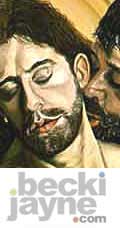
Consequently, in protest, I did not vote after 1992 until the 2000 election when I got a whiff of what Texas Republicans such as George W. Bush would envision for our future (not a pretty picture.). However, I did not remain silent through the 1990s. A blessing in disguise, Clinton's 1993 reversal and the resultant bigotry over gays in the military motivated me to finally undertake painting queer and feminist Christology, art that I had conceptualized in 1991. I decided to answer gay apartheid with artistic courage and foster my spiritual belief that God created who we are albeit a sexual minority. Exercising my faith, I believed that Christ did not condemn lesbians and gays and conceivably could have had a male lover.

Since the fateful 200o election, I have rallied to support Democrats with my money and my vote to blunt the advance of Republicans who pandered to homophobic voters and the Religious Right's anti-gay agenda. I also vehemently opposed the invasion of Iraq and later voted for John Kerry in 2004 both in the primary and the general election. I had put aside my grievance with the Democratic Party over DOMA and its sometimes wishy-washy attitude towards gay equality. But, on Tuesday, my patience ran out.

When Georgia Democratic voters in the 4th District delivered a victory to Hank Johnson by more than 12,000 votes over Cynthia McKinney in the runoff election, I was absent from the approximately 70,000 voters who turned out. My partner and I participated in the primary to stop Ralph Reed (which I'll explain in a minute) and in the 2004 primary when McKinney barely edged out five other contenders. Yet, 33,591 less Democratic voters went to the polls in this July 18 primary compared to the one in 2004. Why?

From my perspective as a registered voter in the 4th District of Georgia, Cynthia didn't give me a reason to vote for her. When Cynthia McKinney did not show up to vote against FMA, I did not feel compelled to show up to vote for her. Her scuffle with the Capitol police didn't overly alarm me and I liked her defiance of Bush over the years. She wasn't perfect but who is? What I cared about was whether she would represent me, her constituent, a lesbian, a marginalized minority. Perhaps I wasn't the only voter who felt this way. Cathy Woolard, a lesbian for whom I voted in the 2004 primary, received 18,164 votes--more than enough votes for McKinney to have cinched the Democratic nomination in this year's primary. But I had had enough of Democrats avoiding the "gay wedge" issue. Candidates would now earn my pink vote. And Cynthia hadn't. So on Georgia's July 18 primary election day, my partner and I did what we thought was best: We asked for Republican ballots to vote specifically against Ralph Reed and for every Republican challenger to a GOP incumbent in the field.

When Cynthia did not win a majority of Democratic votes, a predicament that put her in the position of having to face a runoff with Hank Johnson, I emailed Hank asking him whether he supported gay civil rights. Did I get a reply before the runoff? No! So Tuesday, my partner and I stayed home. I wondered if other disenfranchised lesbian and gay voters had done the same. The 4th District has an enormous gay population with Atlanta as the gay mecca of the South. I also pondered when the election results were tallied, did McKinney lose by forgetting lesbians and gays in her district, by failing to reach out to us? Who can say? I can count two votes she lost because she didn't.

Yesterday, I emailed Hank Johnson again about his views on gay rights. Will I get an answer before November? I dunno. But I do know this. I will no longer vote for a candidate who will not stand up for gays and lesbians. I will not vote against myself just to vote ABAR (anybody but a Republican). After reading Billmon's post last night and the out-of-state lobbying money that was donated to Hank Johnson's campaign, I am less inclined to vote for him.

In surveying Georgia's candidates, I don't feel I have a Democratic candidate who supports me. So sad, so true, and so disappointing. Unlike Democrats with principles and a spine such as Russ Feingold, too many have not heeded the call from civil rights voices such as the late, great Coretta Scott King or the NAACP.

I would mobilize to vote against Perry McGuire whose outrageous remarks about gay teens cannot go unanswered. However, the Democrat incumbent for attorney general, Thurbert Baker, will likely win re-election, so I see no need to go to the polls in November. ABAR is like voting for a Republican on gay civil rights in effect, so why vote for Republican Lite? Hank Johnson has already taken an antiwar position but he has not, at the time of this posting--after I have sent two emails requesting his position on gay civil rights--declared that he will support an end of discrimination against me. If he won't declare his support for my gay brothers, lesbian sisters, my partner, and me, I don't feel compelled to move my feet for him. Maybe he'll come around. I can only hope but we'll see.

As for the rest of Georgia's Democrats, I will seek clarification on their positions on discrimination against gays and lesbians. If I receive no answer or a lackluster response, neither will I answer their call to vote for them. It's as simple as that.

Tuesday, July 11, 2006

The Passion of Christ for today

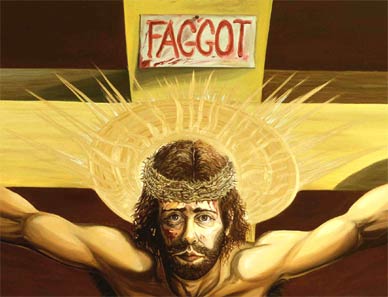
The Crucifixion of Christ, oil on canvas, 1993

When Mel Gibson's The Passion of the Christ first released, I was asked if I was going to see the film to which I retorted, "No, it's heresy. Masters do not suffer," a reaction of anger at the glorification of the suffering of Christ. If one believes in the New Testament stories--Jesus who raised the dead, Jesus who walked on water, Jesus who worked all manner of miracles--how can one logically deduce that Jesus suffered greatly on the cross? What kind of Father God would demand such agony? And why embrace the crucifixion as a tribute to Jesus when his life (not his death) offers so much more appropriately attuned narratives for believers to eulogize and edify?

For now, I'll set aside textual disputes and contradictions between the Gospels only to briefly cite Bart Ehrman from Misquoting Jesus, page 142:

. . .while Luke's source, the Gospel of Mark, portrays Jesus in anguish as he prays in the garden, Luke has completely remodeled the scene to show Jesus at peace in the face of death. The only exception is the account of Jesus's "bloody sweat," an account absent from our earliest and best witnesses. Why would Luke have gone to such lengths to eliminate Mark's portrayal of an anguished Jesus if in fact Jesus's anguish were the point of the story?

It is clear that Luke does not share Mark's understanding that Jesus was in anguish, bordering on despair....

. . .Nowhere is this more evident than in their subsequent accounts of Jesus's crucifixion... [Mark's account] stands in sharp contrast to what we find in Luke. In Luke's account, Jesus is far from silent, and when he speaks, he shows that he is still in control, trustful of God his Father, confident of his fate, concerned for the fate of others.

So the question remains. Why glorify the death and suffering of Jesus? Rev. Irene Monroe at The Witness provides awe-inspiring answers and they supply us with insights into today's false hegemony of guilt, shame, sacrifice, and a valorization of suffering and abuse:

Mel Gibson's The Passion of the Christ has no compassion for those of us relegated to the margins. I am not too certain that the film has any love for Christ, either.

It would be an egregious omission to gloss over the unrelenting violence that took place during Jesus' time, especially in light of the ongoing violence in today's society toward people of color, women, Jews, Muslims, and lesbian, gay, bisexual and transgender people. However, the deification of violence as depicted in the film as redemptive suffering has deleterious implications that are not-so-benignly played out today from the playground to the courtroom.

Also, the film desensitizes killing, giving rise not only to a cavalier attitude to kill those who pose a physical threat to our lives, but also to a self-righteous attitude to kill those who are believed to pose social and political threats to the status quo.

So much of the opposition to same-sex unions is intrinsically tied to a religious belief held by many Christian evangelical heterosexuals. They will by any means possible -- and violence is not excluded -- oppose any bill sanctioning such a union, because their fight is not only just, but it is also redemptive. And many of these Christian evangelical heterosexuals believe that if Christ can suffer as he did up the hill to Golgotha at Calvary, so too can they, as they make their way up to Beacon Hill in Boston to save the sanctity of marriage.

The notion, therefore, of equating violence to redemptive suffering is not only bad theology, but is also a bad paradigm to demonstrate how God, who so loved the world that he offered up his only begotten son to save all of humanity, sacrificed in the form of a sado-masochistic flogging.

Rev. Irene says so much in these few paragraphs that I am astounded that a vast contingency of Christian evangelicals dismiss the ultimate truth, the message--do not crucify, do not judge or condemn, do not harm another of God's children but instead love, help each other, and treat each other as "you would have them do unto you." No amount of distortion and obfuscation can justify the condemnation of any minority based on the teachings of Jesus. Ever. To correct the error, Rev. Monroe explains that we have not grasped the forces underpinning Christ's crucifixion:

However, without the contextualization and accountability of the violence enacted upon Jesus, the cycle of violence continues. As a figure that has dominated Western culture and Christianity for over 2,000 years, too little attention is paid to Jesus' death. If more focus was spent on the reasons for his death and the systems of oppression that brought about his demise, violence against marginalized people would cease to exist.

By focusing on the death of Jesus and how justice might be adjudicated from it, we are forced to remember history. In the year 33 A.D., Jesus was unquestionably a religious threat to conservative Jews because of his iconoclastic views and practice of Jewish Law, and viewed as a political threat to the Roman government simply because he was a Jew.

So, too, today, political and religious factions who wail about being persecuted themselves oppress in continuing a legacy of marginalizing minorities. I daresay some Christians have sown their seeds upon stony ground, among thorns, and on the way-side of fear, violence, ignorance, and complacency.

Artistically, I agree with Rev. Irene that we have not fully incorporated the reasons behind Jesus' crucifixion, which I attempted to articulate in my faggot crucifxion:

Look at the word FAGGOT on the cross. You could substitute the word NIGGER, JEW BOY, HONKIE, REDNECK or BITCH—it all means the same. Anytime anyone rises up in condemnation, hatred or violence against another, Christ is [once again] crucified.

I chose the word FAGGOT because today, gays are socially-acceptable and religiously-justifiable targets for hate. And, just like gays, Jesus was made a hate target in his time because he dared to be different, to tell his understanding of the truth even though his words and his position defied the religious establishment.

Who thinks the placard that bore the phrase, King of the Jews, upon the cross at Calvary was anything but a mockery? Who now dares to mock another child of God as a faggot? What justice permits the vilification and segregation of gays as less than equal citizens so deplorably perpetrated in the name of God? Is such an action an act of love or a reaction to fear? A rising chorus within the psychiatric, psychological, and sociological communities plus some religious denominations have concluded that irrational fear belies such behavior.

In 1993, I completed the crucifixion painting as the Clinton Administration capitulated to congressional homophobes in declaring "Don't Ask, Don't Tell" apartheid of gays in the military. I did not realize the artwork prophesied bloodier scenarios. Rev. Monroe describes a year of "haterati" at its ugliest in 1998. An African-American boy named Emmett Till was lynched, James Byrd Jr. was heinously murdered in East Texas, and gay Matthew Shepard was beaten and tied to a wooden fence, a "cross" of sorts where he was left to die--all hate crimes due to what I would describe as a pervasive culture of violence and bigotry aimed at the Other, the minority. Other examples abound from the 1990s to present, from here in the U.S. to the prisons of Abu Ghraib, Camp Bucca, and elsewhere in Iraq. Also...

During the summer months of 1998, the country was hit with the explosion of "ex-gay" ministry ads that appeared in major newspapers like The New York Times, The Washington Post, and USA Today. The ads were sponsored by a coalition of 15 right-wing Christian organizations calling all lesbian, gay, bisexual and transgender people to convert to heterosexuality.

Let me offer right now use of my faggot crucifixion to any organization who would like to reproduce it on a billboard or in an ad to challenge and protest the misuse of Jesus' teaching. Let the message reflect, they know not what they do but we will no longer tolerate bigotry masquerading as God's justice!

Not once did Christ condemn his gay brothers and sisters and perhaps he had a secret in living the down low. The Pauline text so often quoted to justify the alleged sin of man-on-man sex is hotly debated, yet are we to believe that lesbianism is OK? Ha! Few laypeople understand that scribes occasionally altered Scriptures to fit a prevalent religious bias as was done to limit women's roles in the church. Furthermore, we do not have the original manuscripts. Yes, that's right. Biblical textual scholars tell us we do not have one original manuscript of the Gospels. Instead, we have thousands of derivatives and each differ one from another. So much for the inerrant Word of God. What folly it is to take the Bible literally. And yet, Jesus' ministry and his teachings we can fully understand with a few words--love, forgiveness, compassion, and treating each other respectfully--which uplifts and redeems while a bloodshed theology, as Rev. Irene describes it, denigrates:

For those of us on the margins, a Christology mounted on the belief that "Jesus died on the cross for our sins" instead of "Jesus died on the cross because of our sins" not only deifies Jesus as the suffering servant, but it also ritualizes suffering as redemptive. While suffering points to the need for redemption, suffering in and of itself is not redemptive, and it does not always correlate to one's sinfulness. For example, the belief that undeserved suffering is endured by faith, and that it has a morally educative component to it makes the powerful insensitive to the suffering of others and it forces the less powerful to be complacent to their suffering - therefore, maintaining the status quo.
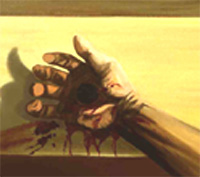
Jesus' suffering on the cross should never be seen as redemptive any more than the suffering of African-American men dangling from trees in the South during Jim Crow America. The lynchings of African-American men were never as restitution for the sins of the Ku Klux Klan, but were, instead, because of their sins that went, for decades, unaccounted for (until the 1951 Federal Anti-Lynching Act was passed). In other words, Jesus' death on the cross and the lynching of African-American are synonymous experiences.

As a deeply controversial icon in Christian liberation theologies for many feminists, womanists, African Americans, and lesbian, gay, bisexual and transgender people, the cross is the locus of redemption insofar as it serves as a lens to critically examine and make the connections between the abuses of power and institutions of domination that brought about the suffering Jesus endured during his time to the abuses of power and institutions of domination that brings about the suffering which women, people of color and sexual minorities are enduring in our present day.

When suffering is understood as an ongoing cycle of abuse that goes on unexamined and unaccounted for, we can then begin to see its manifestation in systems of racism, sexism, classism and heterosexism in our everyday lives. With a new understanding about suffering and how it victimizes the innocent and its aborts the Christian mission of inclusiveness, Jesus' death at Calvary invites a different hermeneutic than its classically held one.

Lesbian, gay, bisexual and transgender people suffer because of well-intended heterosexual Christians' unexamined and unaccounted for acts of homophobia. When these Christians say they love us as sinners, but hate our supposed sin, they are maintaining an unexamined and unaccounted for cycle of spiritual abuse.

Many Christians do not realize that with the classical view of the cross held by many conservatives in their denominations as the exaltation of Jesus as male, Jesus as white, and Jesus as heterosexual, this view not only disinvites the many faces of God that should appear on the cross with Jesus, but it also disinvites solidarity among diverse groups of people who do suffer.

Yes, a different hermeneutic is exactly the need of the hour. To mature spiritually and morally, to progress as a fruitful nation and a beacon for democracy, we must no longer excuse the Dobsons, the Falwells, and the erroneous proposition, to paraphrase Monroe, that Jesus died for our sins when he was crucified because of sin. Therein lies redemption in not only accounting for racism, sexism, homophobia, xenophobia, and any -ism or phobia that excludes one member from the family of humanity, but calling those to account for repeating the sin and promoting it as if it were the truth.

UPDATE: Matt Comer really gets what the painting of The Crucifixion of Christ is about:

Because this message is so strong, it transcends lines of faith and lines of belief. Whatever you do to “the least” of our world’s family, you do to God… and you do to Jesus. If you aren’t the religious type, the message is similar: Whatever you do to “the least” of our world’s family, you do to someone else… for each person is inextricably bound to another; we are all interconnected and interdependent upon each other. When one is hurt, all are hurt. As Wilbur depended on Charlotte and her web, we all depend on each other for life, for joy, for happiness & survival… a huge web of humanity.

Whatever you do to “the least,” you do also to Christ. This painting is such a perfect portrayal of this teaching.