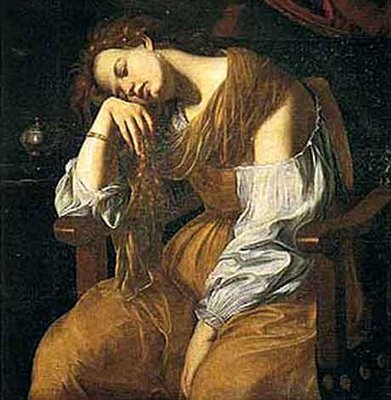
by Artemisia Gentileschi, c. 1621-22, oil on canvas
In the coming weeks, I hope to post a series that will include powerful words, ideas, and criticism from Rev. Irene Monroe, Bishop John Shelby Spong, and others on feminism and lesbian feminism. I'm hopeful that Genet will join me by adding her insights as a voice for the illustrous Lesbianati. This entry, the first of the series, addresses the Bible--the authoritative source of Christianity--as a fountainhead for sexism in America, a previously expressed blog topic I wanted to undertake.
Excerpts from Bart Ehrman's bestseller, Misquoting Jesus illustrate:
How errant Biblical literalism is
The lack of understanding among laypersons that scribes revised manuscripts to reflect their bias, which were then translated into today's modern Bibles
The resultant sexism in the New Testament and
How textual alterations by scribes covered up the prominent roles women held in the early church that were equal to men. One woman, Junia, Paul described as "foremost among the apostles."
Women were integral to Christ's mission and later to the apostle Paul, [pages 178-181, Misquoting Jesus]:
Modern scholars have come to recognize that disputes over the role of women in the early church occurred because women had a role––often a significant and publicly high profile role. Moreover, this was the case from the very beginning, starting with the ministry of Jesus himself. It is true that Jesus's closest followers––the twelve disciples––were all men, as would be expected of a Jewish teacher in first-century Palestine. But our earliest Gospels indicate that Jesus was also accompanied by women on his travels, and that some of these women provided for him and his disciples financially, serving as patrons for his itinerant preaching ministry (see Mark 15:40–51; Luke 8:1–3). Jesus is said to have engaged in public dialogue with women and to have ministered to them in public (Mark 7:24–30; John 4:1–42). In particular, we are told that women accompanied Jesus during his final trip to Jerusalem, where they were present at his crucifixion and where they alone remained faithful to him to the end, when the male disciples had fled (Matt. 27:55; Mark 15:40–41). Most significant of all, each of our Gospels indicates that it was women––Mary Magdalene alone, or with several companions––who discovered his empty tomb and so were the first to know about and testify to Jesus's resurrection from the dead (Matt. 28:1–10; Mark 16:1–8; Luke 23:55–24:10; John 20:1–2).
Why were women so connected to Jesus's ministry when the Jewish tradition at that time treated women as underlings to men?
It is intriguing to ask what it was about Jesus's message that particularly attracted women. Most scholars remained convinced that Jesus proclaimed the coming Kingdom of God, in which there would be no more injustice, suffering, or evil, in which all people, rich and poor, slave and free, men and women, would be on equal footing. This obviously proved particularly attractive as a message of hope to those who in the present age were underprivileged––the poor, the sick, the outcast. And the women.
[...]
But we do not need to wait until the late second century to see that women played a major role in the early Christian churches. We already get a clear sense of this from the earliest Christian writer whose works have survived, the apostle Paul. The Pauline letters of the New Testament provide ample evidence that women held a prominent place in the emerging Christian communities from the earliest of times. We might consider, for example, Paul's letter to the Romans, at the end of which he send greetings to various members of the Roman congregation (chapter 16). Although Paul names more men than women here, it is clear that women were seen as in no way inferior to their male counterparts in the church. Paul mentions Phoebe, for example, who is a deacon (or minister) in the church of Cenchreae, and Paul's own patron, whom he entrusts with the task of carrying his letter to Rome (vv. 1–2). And there is Prisca, who along with her husband, Aquila, is responsible for missionary work among the Gentiles and who supports a Christian congregation in her home (vv. 3–4: notice that she is mentioned first, ahead of her husband). Then there is Mary, a colleague of Paul's who works among the Romans (v. 6); there are also Tryphaena, Tryphosa, and Persis, women whom Paul calls his "co-workers" in the gospel (vv. 6, 12). And there are Julia and the mother of Rufus and the sister of Nereus, all of whom appear to have a high profile in the community (vv 13, 15). Most impressive of all, there is Junia, a woman whom Paul calls "foremost among the apostles" (v. 7). The apostolic band was evidently larger than the list of twelve men with whom most people are familiar.
Women, in short, appear to have played a significant role in the churches of Paul's day. To some extent, this high profile was unusual in the Greco-Roman world. And it may have been rooted, as I have argued, in Jesus's proclamation that in the coming Kingdom there would be equality of men and women. This appears to have been Paul's message as well, as can be seen, for example, in his famous declaration in Galatians:
For as many of you as were baptized into Christ have put on Christ. There is neither Jew nor Greek, neither slave nor free; there is not male and female; for all of you are one in Jesus Christ. (Gal. 3:27–28)
The equality in Christ may have manifested itself in the actual worship services of the Pauline communities. Rather than being silent "hearers of the word," women appear to have been actively involved in the weekly fellowship meetings, participating, for example, by praying and prophesying, much as the men did (I Corinthians 11).
Being unusual in the Greco-Roman world, women playing a significant role created debate and disputes among church leaders (prejudice dies hard) that ultimately impacted Biblical interpreters. Ehrman goes on to write [pages 181, Misquoting Jesus]:
At the same time, to modern interpreters it may appear that Paul did not take his view of the relationship of men and women in Christ to what could be thought of as its logical conclusion. He did require, for example, that when women prayed and prophesied in church they do so with their heads covered, to show that they were "under authority" (I Cor. 11:3–16, esp. v. 10). In other words, Paul did not urge a social revolution in the relationship of men and women––just as he did not urge the abolition of slavery, even though he maintained that in Christ there "is neither slave nor free." Instead he insisted that since "the time is short" (until the coming of the Kingdom), everyone should be content with the roles they had been given, and that no one should seek to change their status––whether slave, free, married, single, male, or female (I Cor. 7:17–24).
My, my, have times changed but not without resistant Biblical literalists using key Scriptures to sustain their bigotry. The world no longer condones slavery although some Christian congregations attempted to justify the slavocracy of the ante-bellum South. Politically and culturally, through the misuse of an errant religious tradition, a Jim Crow hegemony affirmed that people of color were inferior to whites and should be segregated, which excused discrimination against them.
Not until the civil rights movement of the 1960s did legal and cultural racist constructs recede although sadly we can still witness the legacy of America's racism. Yet, under the emergence of the Religious Right, women face formidable challenges in overcoming obstacles to reproductive health, financial parity, autonomy, and in avoiding the epidemic of rape and domestic violence. For an insightful look into the war on women at The Nation, read Martha Nussbaum's review of Catherine A. MacKinnon's book, Are Women Human? Add another book to my wishlist.
The patriarchy still remains King of the Hill, and in my opinion, anti-feminist bias rooted in a persistence of an errant Christian tradition insidiously underpins an unspoken prejudice--in some cases, an explicit calling--that women submit to men.
Ehrman elaborated about the divergent role of women in ancient Christianity that ultimately resolved in a subversion of the sacred feminine [pages 181-182, MJ] with my emphasis added:
At best, then, this can be seen as an ambivalent attitude toward the role of women: they were equal in Christ and were allowed to participate in the life of the community, but as women, not as men (they were, for example, not to remove their veils and so appear as men, without an "authority" on their head). This ambivalence on Paul's part had an interesting effect on the role of women in the churches after his day. In some churches it was the equality in Christ that was emphasized; in others it was the need for women to remain subservient to men. And so in some churches women played very important, leadership roles; in others, their roles were diminished and their voices quieted. Reading later documents associated with Paul's churches, after his death, we can see that disputes arose about the roles women should play; eventually there came an effort to suppress the role of women in churches altogether.
This becomes evident in a letter that was written in Paul's name. Scholars today are by and large convinced that I Timothy was not written by Paul but by one of his later, second-generation followers.3 Here, in one of the (in)famous passages dealing with women in the New Testament, we are told that women must not be allowed to teach men because they were created inferior, as indicated by God himself in the Law; God created Eve second, for the sake of the man; and a woman (related to Eve) must not therefore lord it over a man (related to Adam) through her teaching. Furthermore, according to this author, everyone knows what happens when a women does assume the role of teacher: she is easily duped (by the devil) and leads the man astray. So, women are to stay at home and maintain the virtues appropriate to women, bearing children for their husbands and preserving their modesty. As the passage itself reads:
Let a woman learn in silence with full submission. I permit no woman to teach or to have authority over a man; she is to keep silent. For Adam was formed first, then Eve; and Adam was not deceived, but the woman was deceived and became a transgressor. Yet she will be saved through childbearing, provided they continue in faith and love and holiness, with modesty. (I Tim. 2:11–15).
This seems a long way from Paul's view that "in Christ there is . . . not male and female." As we move into the second century, the battle lines appear clearly drawn. There are some Christian communities that stress the importance of women and allow them to play significant roles in the church, and there are others that believe women must be silent and subservient to the men of the community.
The scribes who were copying the texts that later became scripture were obviously involved in these debates. And on occasion the debates made an impact on the text being copied, as passages were changed to reflect the views of the scribes who were reproducing them. In almost every instance in which a change of this sort occurs, the text is changed in order to limit the role of women and to minimize their importance in the Christian movement.
Now to examine the anti-feminist scriptural alterations that scribes made to diminish women (with my emphasis added) from Bart Ehrman [pages 183-184, MJ]:
One of the most important passages in the contemporary discussion of the role of women in the church is found in I Corinthians 14. As represented in most of our modern English translations, the passages reads as follows.
33 For God is not a God of confusion but one of peace. As in all the churches of the saints, 34 let the women keep silent. For it is not permitted for them to speak, but to be in subjection, just as the law says. 35 But if they wish to learn anything, let them ask their own husbands at home. For it is shameful for a woman to speak in church. 36 What! Did the word go forth only from you, or has it reached you alone?
The passage appears to be a clear and straightforward injunction for women not to speak (let alone teach!) in the church, very much like the passage from I Timothy 2. As we have seen, however, most scholars are convinced that Paul did not write the I Timothy passage, because it occurs in a letter that appears to have been written instead by a second-generation follower of Paul in his name. No one doubts, however, that Paul wrote I Corinthians. But there are doubts about this passage. For as it turns out, the verses in question (vv. 34–35) are shuffled around in some of our important textual witnesses. In three Greek manuscripts and a couple of Latin witnesses, they are found not here, after verse 33, but later, after verse 40. That has led some scholars to surmise that the verses were not written by Paul but originated as a kind of marginal note added by a scribe, possibly under the influence of I Timothy 2. The note was then inserted in different places of the text by various scribes––some placing the note after verse 33 and others inserting it after verse 40. There are good reasons for thinking that Paul did not originally write these verses. For one thing, they do not fit well into their immediate context. In this part of I Corinthians 14, Paul is addressing the issue of prophecy in the church, and is giving instructions to Christian prophets concerning how they are to behave during the Christian services of worship. This is the theme of verses 26–33, and it is the theme again of verses 36–40. If one removes verses 34–35 from their context, the passage seems to flow seamlessly as a discussion of the role of Christian prophets. The discussion of women appears, then, as intrusive in its immediate context, breaking into the instructions that Paul is giving about a different matter.
Not only do the verses seem intrusive in the context of chapter 14, they also appear anomalous with what Paul explicitly says elsewhere in I Corinthians. For earlier in the book, as we have already noticed, Paul gives instructions to women speaking in the church: according to chapter 11, when they pray and prophesy––activities that were always done aloud in the Christian services of worship––they are to be sure to wear veils on their heads (11:2–16). In this passage, which no one doubts Paul wrote, it is clear that Paul understands that women both can and do speak in church. In the disputed passage of chapter 14, however, it is equally clear that "Paul" forbids women from speaking at all. It is difficult to reconcile these two views––either Paul allowed women to speak (with covered heads, chapter 11) or not (chapter 14). As it seems unreasonable to think that Paul would flat out contradict himself within the short space of three chapters, it appears that the verses in question do not derive from Paul.
And so on the basis of a combination of evidence––several manuscripts that shuffle the verses around, the immediate literary context, and the context within I Corinthians as a whole––it appears that Paul did not write I Cor. 14:34–35. One would have to assume, then, that these verses are a scribal alteration of the text, originally made, perhaps, as a marginal note and then eventually, at an early stage of the copying of I Corinthians, placed it in the text itself. The alteration was no doubt made by a scribe who was concerned to emphasize that women should have no public role in the church, that they should be silent and subservient to their husbands. This view then came to be incorporated into the text itself, by means of a textual alteration.4
On page 185, Ehrman describes the woman Junia who was "foremost among the apostles" but she was magically transformed into a man (with emphasis):
We might consider briefly several other textual changes of a similar sort. One occurs in a passage I have already mentioned, Romans 16, in which Paul speaks of a woman, Junia, and a man who was presumably her husband, Andronicus, both of whom he calls "foremost among the apostles" (v. 7). This is a significant verse, because it is the only place in the New Testament in which a woman is referred to as an apostle. Interpreters have been so impressed by the passage that a large number of them have insisted that it cannot mean what it says, and so they have translated the verse as referring not to a woman named Junia but a man names Junias, who along with his companion Andronicus is praised as an apostle. The problem with this translation is that whereas Junia was a common name for a woman, there is no evidence in the ancient world for "Junias" as a man's name. Paul is referring to a woman named Junia, even though in some modern English Bibles (you may want to check your own!) translators continue to refer to this female apostle as if she were a man named Junias. 5
Some scribes also had difficulty with ascribing apostleship to this otherwise unknown woman, and so made a very slight change in the text to circumvent the problem. In some of our manuscripts, rather than saying, "Greet Andronicus and Junia, my relatives and fellow prisoners, who are foremost among the apostles," the text is now changed so as to be more readily translated: "Greet Andronicus and Junia, my relatives; and also greet my fellow prisoners who are foremost among the apostles." With this textual change, no longer does one need to worry about a woman being cited among the apostolic band of men!
Ha! A quick Bible Gateway search of Romans 16:7 in the New International Version (NIV), the New American Standard Bible (NASB), the Contemporary English Version (CEV), the Worldwide English (New Testament) (WE), the Holman Christian Standard Bible (HCSB), and other versions name Junia the woman as Junias or Junia the man.
In the King James Version (KJV), the New King James Version (NKJV), and other Bible editions, we can read a derivative of the latter alteration that changes the text to eliminate any reference to Junia as among the apostolic band of men.
Again on page 185, Ehrman points out another textual change to reduce women's stature (with emphasis):
A similar change was made by some scribes who copied the book of Acts. In chapter 17 we learn that Paul and his missionary companion Silas spent time in Thessalonica preaching the gospel of Christ to the Jews of the local synagogue. We are told in verse 4 that the pair made some important converts: "And some of them were persuaded and joined with Paul and Silas, as did a great many of the pious Greeks, along with a large number of prominent women."
The idea of women being prominent––let alone prominent converts––was too much for some scribes, and so the text came to be changed in some manuscripts so that we are told: "And some of them were persuaded and joined with Paul and Silas, as did a great many of the pious Greeks, along with a large number of wives of prominent men." Now it is the men who are prominent, not the wives who converted.
Among Paul's companions in the book of Acts were a husband and wife named Aquila and Priscilla; sometimes when they are mentioned, the author gives the wife's name first, as if she had some kind of of special prominence either in the relationship or in the Christian mission (as happens in Rom. 16:3, where she is called Prisca). Not surprisingly, scribes occasionally took umbrage at this sequencing and reversed it, so that the man was given his due by having his name mentioned first: Aquila and Priscilla rather than Priscilla and Aquila. 6
In short, there were debates in the early centuries of the church over the role of women, and on occasion these debates spilled over into the textual transmission of the New Testament itself, as scribes sometimes changed their texts in order to make them coincide more closely with the scribes' own sense of the (limited) role of women in the church.
To this day, we witness the subversion of women in religion. The Vatican continues to ban women from the priesthood. In June 2006, U.S. Episcopalians elected Katharine Jefferts Schori as the first female bishop of the national churches in the worldwide Anglican Communion. What took them so long!? And what mindset and attitude questions why the "choice" of a female bishop complicates the already difficult relations between the American denomination and its fellow Anglicans? Has male resentment over an alpha vagina leeched its poison into our marrow with the diseased thought that women are trouble and less desirable leaders than men? Where's the missing positive, the balance to the bias of a subservient women's role in church and beyond? How have women come to accept second best as if they lived in an Updike world as "house slaves of the A&P?"
I remember clashing with a southern gay gent over the admittance of Shannon Faulkner into the Citadel and I was surprised at anti-feminine bias spouted by an effeminate male. I could have had a more enlightening conversation with a brick wall sans the graffiti smear, "Bi-yotch." How inconvenient for men when women rock the boat with their audacity--demanding that an institution supported by their tax dollars ought to include them! Such a quibble. The whining hurts my ears went the dismissive male harumph.
I'm sure if I dug around I could google up statistics about the state of women's affairs--the assault on contraception, women's health, wage discrepancies, sexual harassment, violent and sex crimes, leisure time, wealth distribution, and positions of power--I could prove that it's still a man's world overlaid with quotes from misogynist prose you can hear on TV and the radio out of the mouths of the Limbaugh punditocracy and religious wacky doodles. I don't accept factoids and artificial rhetoric disguised as a string of pearly wisdom as permanent feminine reality. Yes, we can change the systems that underpin sexism, racism, and all the other hang-ups. The path of adversity, of resistance, the bigger challenge cuts through a landscape of single-issues to the source--the heart and mind that assigns value to men more than women. To transform beliefs, a revolution would entail both one-on-one interactions and collectively as an interlaced unified force. Isn't it time we seriously got to work on healing vagina resentment and the false aggrandizement of penis? Doesn't the error emphasize the flesh over the spirit?
I entitled this post within the context of Biblical sexism but the better frame--now that I have processed my thoughts on this subject and I'm sure more will evolve--is how sexism as male superiority and domination has invaded even our sacred texts in the annihilation of the sacred feminine and women's voices. With a religious authority such as the Bible deposited into the collective mind receptacle, the traditional church has taught the American layperson what the Scriptures were edited to dogmatize. We can understand the powerful influence that these beliefs have had on men's and women's attitudes and the consequential probable reality. Relegated to a secondary place in God's world, trickling down from a Godhead across the land to the tiniest shopping mall berg, women have been defined in society, industries, professions, and politics as less than, not good enough, not as valuable as men. How can we change it? By heightening the awareness of who and what is responsible for the gender gap in a no holds bar riffing of the truth is the first step. Secondly, overhaul the legacy that promotes woman as Adam's Rib, that says Eves derive their source from Adams, that Eves aren't a primary first-born gender but a sex created from Man in not being deemed worthy to spring directly from God. Surely, no one would suggest that God isn't omnipotent enough to fashion two unique primogenital sexes endowed with divine power at the same time?
In political circles, executive boardrooms, and polite gatherings, no one dares to assert that women aren't men's equal and gals were made for guys unless one is rude, arrogant, or spoiling for a lawsuit. The need to appear civilized, therefore, has shifted sexists to adopt an underground of code words--radical feminism, feminazis, androgynous society, social experimentation, political correctness, academic intolerance, to name a few terms that target stereotypical female behavior.
I hope brave women and men of all ilks--religious and secular--will compassionately and fairly examine the facts to no longer accept a false perception and a greediness of one's gender turf to continue to forge divergent realities for the sexes. Ha! Perhaps in our examination of the institutional face of religion and the stories of our culture, we ought to reverse the paradigm to expose the supposition behind the lie: Why are men inferior to women?
It's time, as Rev. Irene wrote, for a different hermeneutic than [the] classically held one, a faith in which God created the human genders simultaneously and both in divinity. It's time for new stories. Scriptures contain a male bias constructed in the past that's been perpetrated generation to generation for centuries. Why not listen anew to the Living Presence? For there's no better Source for the believer of today than the kingdom of God at hand, alive within us.
FOR THE RECORD: I'm a strong advocate of the separation of church and state. My religion nor should any other religion be imposed upon anyone. Funny how we hear about free will, and then those who espouse it, work tirelessly to end it. God save us from your people.