Showing posts with label Rev. Irene Monroe. Show all posts

Monday, April 14, 2008

Power rift

Obama is standing on the "shoulders of giants." But does that qualify him to lead?

My friend Rev. Irene Monroe (bio) posted a column last week on Obama's absence at the 40th anniversary commemoration of MLK's assassination. Clinton and McCain attended. But where was Obama?

One of Obama's political advisors, Princeton University professor and author of Race Matters, Cornel West criticized Barry at HuffPo:

“I want to say that I’m deeply disappointed that my dear brother Barack Obama decided not to go pay tribute and lay his wreath for the great Martin Luther King, Jr. That brother Martin’s profound love and deep sacrifice for black people, America and humanity is in no way reducible to political calculations, even for the campaign for presidency. That Martin Luther King Jr.’s deep commitment to unarmed truth and unconditional love can in no way be subject to strategies for access to political power.”

Rev. Irene pondered:

Was this a public backhand slap from West signaling to the public, as well as to Obama, his concerns about Obama’s calculated ambitions to the White House?

Or, as many Obama supporters in the African American community are now speculating, is there both a personal and ideological rift between West and Obama?

Given West’s prominence and respect in the African American community nationwide, the Obama campaign knows if West breaks publicly from the campaign he’ll take a substantial portion of black voters away from Obama come November (if Obama wins the Democratic nomination).

Having won the majority of African American voters in the Tennessee primary, Obama may have felt he did not need to come back to the state to do face time.

But black talk show radios were abuzz with listeners calling in expressing their disappointment.

Tavis Smiley, one of America’s most celebrated and respected media personalities and author of the bestseller Covenant With Black America, called into the Tom Joyner Morning Show. Smiley asked listeners if Obama’s absence was another signal of Obama only courting the African American vote when it is political advantageous for him to do so.

When the State of the Black Union hosted in NOLA convened, an "event [that] gathers a 'Who’s Who' of black intellectuals, pundits, activists, entertainers and politicians to discuss and brainstorm where black America is and where it is headed," Barry was absent again. He offered his wife Michele as his surrogate, but Obama, too busy on the campaign trail to attend this most auspicious summit, caused African Americans to question if his ambitions were most important to Obama. Rev. Irene pointed to criticism from Darryl Fears:

As the first black person to have a legitimate shot at a presidential nomination, defeating Sen. Hillary Clinton's rich campaign juggernaut, Obama is virtually a third civil rights movement, the manifestation of Rev. Martin Luther King Jr.'s dream. His candidacy has produced a fervor in black America born of centuries of wanting. Nearly every black vote that Clinton thought was hers at the beginning of the race has been siphoned by Obama.

Each of the presidential candidates were invited to speak [at the State of the Black Union], but only Sen. Hillary Clinton accepted. Clinton is desperate to bolster her flagging campaign with a larger share of the black vote after losing all but a small percent to Obama.

Rev. Irene concluded in her column:

And in Obama winning our votes, he must also hear and heed to the moral imperative and hurt expressed by West:

“I have a very deep disagreement with my dear brother, Barack Obama — in this case, commitment to truth is in tension with the quest for power.”

Otherwise, we must wonder, if Obama can diss King, what manner of man do we have here?

According to Emil Jones, Jr., Obama is a man who seeks pow-er. That's what the president of the Illinois Senate said Obama wanted of him in 2003.

"And [Obama] said to me. . .‘You’re the senate president now, and with that, you have a lot of pow-er.’ ” Jones stretched out the word, as if savoring the pleasure of it, and his voice became very quiet as he continued: “And I told Barack, ‘You think I got a lot of pow-er now?,’ and he said, ‘Yeah, you got a lot of pow-er.’ And I said, ‘What kind of pow-er do I have?’ He said, ‘You have the pow-er to make a United States sen-a-tor!’ ” Jones let out a soft, smoky laugh. “I said to Barack, I said, ‘That sounds good!’ I said, ‘I haven’t even thought of that.’ I said, ‘Do you have someone in mind you think I could make?,’ and he said, ‘Yeah. Me.’ ”

Jones let the words hang for a moment, and then went on. “The most interesting conversation. And so I said to him, ‘Let me think about this.’ ” Obama knew that Jones’s support could single-handedly freeze the discretion of other powerful politicians in the state, and put endorsements of possible rivals on ice. “We met a little later that day, and I said, ‘That sounds good. Let’s go for it.’ ”

The rest is history.

Seeking power isn't bad or wrong if one's intentions to use it once acquired hastens the good of everyone. Those who share power, serve it justly with '"unarmed truth and unconditional love." Think of great people of history who have done just that: Dr. King, JFK, Mother Teresa, Ghandi, Susan B. Anthony, and so forth.

I didn't personally like LBJ, but in the political arena, he exercised presidential power to push civil rights legislation responding to Dr. King's righteous appeals for justice, signed it into law, and did so at the detriment to his party. Truman exhibited his power when he ended racial segregation of the military by executive order at the expense of his party, a decision that initially precipitated the exodus of Dixiecrat segregationists to the GOP that eventually transformed the South into a Republican bastion. These were not perfect men. I vehemently disagreed with their use of military force. However, these examples were acts of sacrifice to answer the call of courage grasping the levers of power embodied in the Constitution that we are all created equal.

As Maya Angelou so beautifully explained, "Without courage, we cannot practice any other virtue with consistency." And what is power without virtue?

Consider Obama's opposition to a revote in Michigan and Florida. Is this a positive applications of his pow-er? Or is he more interested in winning? Rewind Donnie McClurkin. Was his using his pow-er to denounce homophobia? Or was he pandering to homophobic voters? What manner of pow-er did he display to billionaires at a fundraiser in associating the Clinton Administration's job growth with Bush's abysmal record and in belittling small town folks by characterizing them as "bitter" and clingy?

Obama's silence against misogyny and sexism--attacking his opponent Hillary Clinton's emotions, and in so doing, those of women in general--tells me all I need to know about the nature of the pow-er he seeks.

Friday, August 04, 2006

Mel Gibson, hate speech, and media

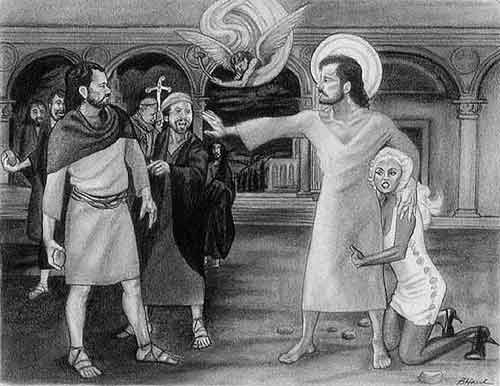
The Stoning of the Drag Queen, graphite on paper

I swore to myself that I wasn't going to join the furor over Mel Gibson but Rev. Irene Monroe tied the subject to hate speech and how name-calling has become mainstream:

Hate speech is not a passive form of public speech. And one of the signs of an intolerant society is its hate speech, whether used jokingly or intentionally, aimed at specific groups of people. When this form of verbal abuse becomes part and parcel of the everyday parlance between people, we have created a society characterized by its zero-tolerance of inclusion and diversity, where name-calling becomes an accepted norm.

Lately this Republican political era of “compassionate conservatism” has brought forward an unabashed no-holds-barred attitude when it comes to passionate invective hurled at queers, African-Americans, and Jews.

In an interview with Ann Coulter, author of Godless: The Church of Liberalism, on the July 27 edition of MSNBC's Hardball with host Chris Matthews, Coulter called former vice president Al Gore a "fag,” and she hinted that Bill Clinton might be gay.

[...]

Let us not forget that the word and image of fag derives from the word faggot, which is a bundle of sticks for burning, and that LGBTQ people were supposedly righteously burned at the stake in medieval England.

And let us not forget Matthew Shepard, the openly gay Wyoming student who in 1998 was bludgeoned and left to die in near-freezing temperatures while tethered to a rough-hewn wooden fence.

Or 1999, when Billy Jack Gaither, a well-respected and beloved textile worker in Alabama, was bludgeoned with an ax handle, burned, and left to die on a pile of tires because he was gay.

And some claim the Bible refers to us stoking the fires of hell.

But the real hell we LGBTQ people confront from this type of name-calling and stereotyping is a societal disparage of sexual relations between people of the same gender, in a society where both the church and government bar us from marriage, many states bar us from adoption, and the federal government forbids our serving in the military.

According to the National Mental Health Association, gay teens hear "anti-gay slurs such as 'homo', 'faggot' and 'sissy' about 26 times a day or once every 14 minutes." Why aren't schools stopping this verbal abuse? Or worse. Almost a third of "gay youth had been threatened or injured at school in the last year alone!" Unbelievable! Can you imagine such a situation today for African-Americans? For Jewish kids? Just for being who they are? Well, maybe. And yet our society turns a deaf ear especially to bigotry and bullying that targets gays and lesbians--child or adult. Shame, shame.

More shameful, gay news media report Georgia's Republican candidate for attorney general compared gay teens to pedophiles. Where are traditional media's outcry? The local newspaper story? A candidate for the state's top law official doesn't understand who the overwhelming majority of child molesters are or the difference between a pervert and a gay or lesbian teenager! Is this conservative ignorance and bigotry to the tenth power or what? And what about the media's complicity by not reporting homophobic McGuire's remarks? I checked Google News a minute ago and not one U.S. non-gay news media outlet (except for Christian news) popped up in search results. Maybe later.

OTOH, if you've seen the news about Gibson (how could you miss it?), you've heard the anti-Semitic, sexist, vain, and profane spew that Catholic conservative Mel drunkenly gushed at police officers during his arrest. But I hadn't heard Gov. Mitt Romney's tar baby remark. Rev. Irene comments in response:

The relationship between homophobia and racism is shown in how LGBTQ and African-American civil rights struggles are pitted against each other by our enemies. It also appears in the federal government’s new HIV/AIDS supposed prevention program, which requires all public-health authorities and agencies to report the identities of HIV-positive patients. It’s a program in which African-Americans—straight or queer—will ostensibly feel profiled.

Language is a representation of culture, and it perpetuates ideas and assumptions about race, gender, religion, and sexual orientation that we consciously, and unconsciously, articulate in our everyday conversations about ourselves and the rest of the world—and, consequently, transmit generationally.

The liberation of a people is also rooted in the liberation from abusive language, which is essentially hate hurled at them. Using epithets, especially jokingly, does not eradicate its historical baggage or the existing social relations among us. Instead, dislodging these epithets from their historical context makes us insensitive and arrogant to the historical injustices done to specific group of Americans.

It allows all Americans to become numb to the use and abuse of the power of hate speech because of the currency these epithets still have.

Any kind of hate speech, sugarcoated with humor or irony or not, thwarts the daily struggle in which many us engage in trying to ameliorate human relations.

I can't decide which medium offers the worst examples of hate speech: online or offline, the blogosphere or conservative TV, radio, or newspapers? Bloggers and their comment threads host some of the most vile language I've ever read (More examples here and a diatribe here. H/t to Pam). Yet, the insidious, subtly-parsed bigoted speech--in the case of Ann Coulter types, blatant defamation--disseminated by the talking heads at Fox News, Chris Matthews, et al may cause far more damage than the blogosphere with its perceived credibility, its frequency, and its sheer reach into the public realm. As always, Media Matters can supply a regular dose of harsh language broadcasted on any day of the week. A few examples:

Boortz: Adults earning minimum wage are "incompetent", "ignorant", "stupid", "worthless," and "pathetic"

O'Reilly blasts "smear merchants" and "vampires" criticizing Mel Gibson; Rivera smears Olbermann, Stewart, and Colbert

Coulter put "even money" on Sen. Clinton "[c]oming out of the closet"

And then we have the examples of deceptive disinformation, specious propaganda, and downright ugly lies.

I'll confess my errors of referring disparagingly to "wacky doodles," the "Codpiece-in-Chief," and other sarcastic names aimed at Republicans and the Religious Right in my fondness for Hunter Thompson and Gonzo journalism. I promise to temper my rhetoric without diluting my criticism or passion for cutting-edge art. Sometimes telling the unvarnished truth is all that's needed to expose a lie, an atrocity, a grievance, or an injustice. May not cut through today's shrill atmosphere but sometimes pictures can communicate more quickly.

Earlier today, TMZ reported that Rabbi David Baron invited Mel Gibson to the Temple of the Arts for a Yom Kippur appearance so the celebrity could deliver a public apology. In his letter to his congregation (PDF), Baron wrote that he would pre-screen Gibson's penitence and sincerity, address his father's Holocaust denials, and examine whether Mel had the adequate "willingness to take the necessary steps to heal the pain he has caused." The good rabbi then closed his letter with a remembrance:

Lastly, our tradition teaches us that when someone offers a direct personal apology, in public no less, we should be prepared to open ourselves to forgiveness. This is especially true if the offending party is prepared to make amends and promises not to repeat the same offense. Please remember we are not dealing with Yasser Arafat or Hezbollah whose words and actions have resulted in the deaths and maiming of hundreds of innocent people. We are dealing with a celebrity whose alcoholic problem has exposed out latent anti-Semitism. Better a repentant sinner than an unrepentant one.

What are the chances Mel will follow through with an apology at the temple? I dunno but I wish that a major Christian church or minister would bravely invite right-wing homophobes--religious and/or political leaders--to his or her services to make amends to the LGBT community. Wouldn't that be something? More astounding, what if the news media actually covered it? Without hate speech.

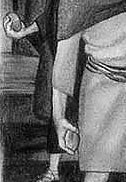
IMAGES: At the top, The Stoning of the Drag Queen with cropped close-ups. Plus, the mug shot of Mel Gibson from his arrest.

Thursday, August 03, 2006

Armageddon: Bible literalists got it wrong


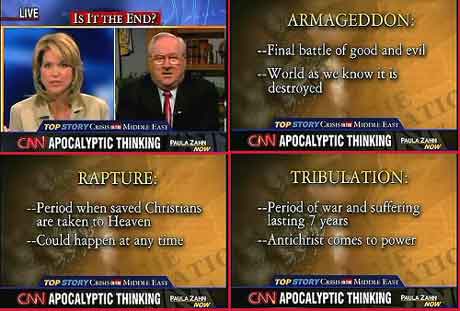
The recent events in Israel, Lebanon, and the Mideast have stimulated media coverage on the subject of eschatology--the End Times, Armageddon, the Rapture, and the Second Coming. Media Matters reported:

On July 31, Paula Zahn Now featured a segment on "whether the crisis in the Middle East is actually a prelude to the end of the world," marking the third time in nine days that CNN has devoted airtime to those claiming that the ongoing Mideast violence signals the coming of the Apocalypse.

MM has more on the ravings of Tucker Carlson on the subject.

For an enlightened take on the Apocalypse, in What's the Matter with Jesusland?, Rev. Irene Monroe illuminates:

I agree with my neighbor that America is at an End Time, but for different reasons. The nation has not been so polarized since the Civil War. Bush's win has politically realigned the Old Confederate South. We are at a nadir with respect to religious plurality and tolerance. We have confused prejudice for moral values, and we have hearkened back to an era of anti-intellectualism, pre-Enlightenment, where the theories of creationism are played in oppositional discourse with those of evolutionism.

And while America tramples into foreign lands to obliterate the terrorism fueled by the religious rhetoric of Muslim fundamentalists like al-Qaeda and Sunni hardliners, America fails to look into its own backyard to see the deleterious effects of its tyranny of Christian fundamentalism.

End Timers say the Real ID Act sets up the mechanism for the "mark of the beast" mentioned in Revelation 13. The Book of Revelation! Oh, for God's sake. Here we go again with the Biblical literalists' error in promoting an interpretation of a translation based on faulty ancient manuscripts that in no way offers us the truth about God or the teachings of Jesus. Why do Christians still rely on a book littered with mistakes when they have access to God directly for instruction and inspiration moment-by-moment in their lives? Do they think God is dead, deaf, or mute? I believe that God is a Living Presence that still speaks to us if we but listen.

Johann Albrecht Bengel, a German Lutheran minister and professor, acted as the Hal Lindsey and the Tim LaHaye of the 1700s. He believed that the end of world would occur in 1836. He was wrong! It's now 2006 and we're still here on the planet nearly 200 years later. Numerous people have erroneously prophesied the End Times and they were wrong too. Televangelist and former Republican presidential candidate Pat Robertson foretold that "the world would end in the fall of 1982." See! What did he know? Amazingly, the Armageddon myth persists.

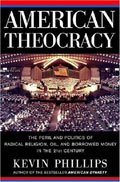
Citing MM on "a CNN Harris interactive poll back in 2002, almost 60 percent of Americans think that the end of the world, as predicted in the Bible's Book of Revelation, will happen, and 17 percent believe it will happen during their lifetimes." Such poppycock has stubbornly endured for centuries and indeed has caused some dangerous implications for the future of American democracy, the impact of global warming on the environment, U.S. foreign policy, the economy, and our stability as a nation. Like extremist Muslims who terrorize and murder in the name of Allah, radical forms of wacky doodle Christianity may inadvertently kill hundreds, thousands, perhaps tens of thousands (or worse!) of our most vulnerable by deferring responsibility for the health and well-being of our citizenry to an imaginary Rapture that never happens; by abandoning sound ecological, social, and fiscal programs deemed unnecessary due to the presumption of an impending Armageddon. If we don't take action to minimize these virulent, destructive forms of Christian theocon influence in American politics before it's too late, we may not avert the nightmarish results of an aggressively zealous and extreme aberration of Christ's teachings that GOP strategist Kevin Phillips outlined in his book, American Theocracy. You think I'm joking? So far, this summer's heat wave has killed more than 160 Californians--"greater than other, better-known natural disasters, including the Loma Prieta and Northridge earthquakes"--and 12 Missourians. Between the unresolved energy crisis, the dismantling of government, the erosion of Medicaid/Medicare funding, VA cuts, the uninsured, the decline of a living wage, the aversion to science, and the effects of global warming, to name a few, it's irresponsible to think that more won't die in denial of the crises we face in being hamstrung by theocon fundamentalists looking for Jesus to return at any minute. Using the Bible as justification, particularly the Book of Revelation, leads into temptation to look the other way when so much is at stake. But worse, the Armageddon concept has been based on fallacious interpretations of the literalist's view of the Bible.

Bart Ehrman, who I earlier quoted on the textual changes altered to subvert the role of women in the church, writes (page 109) in Misquoting Jesus that 18th century apocalyptic Johann Albrecht Bengel (with emphasis):

. . .became disturbed by the presence of of such a large array of textual variants in the manuscript tradition of the New Testament, and was particularly thrown off as a twenty-year-old by the publication of Mill's [1707 Greek New Testament] edition and its thirty thousand places of variation. These were seen as a major challenge to Bengel's faith, rooted as it was in the very words of the scriptures.

So Bengel set about to correct a multitude of errors. Only one problem, which needs repeating ad nauseum until people who rely on the literal words of the Bible finally understand--and that issue is there is NO original manuscript of the New Testament! Nada. Zilch. It does not exist! What we have are reconstructions developed over the centuries--not in Jesus' days or even in the decades that followed him--from thousands of manuscript copies, none of which match word for word. As textual scholar Ehrman explained (page 7, with emphasis):

I became interested in the manuscripts that preserve the New Testament for us, and in the science of textual criticism, which can supposedly help us reconstruct what the original words of the New Testament were. I kept reverting to my basic question: how does it help us to say that the Bible is the inerrant word of God if in fact we don't have the words that God inerrantly inspired, but only the words copied by the scribes––sometimes correctly but sometimes (many times!) incorrectly? What good is it to say that the autographs (i.e., the originals) were inspired? We don't have the originals! We have error-ridden copies, and the vast majority of these are centuries removed from the originals and different from them, evidently, in thousands of ways.

The New Testament apocalyptic prophesies and pervasive thinking that evangelical eschatalogists proselytize are based on errors!

I'll give you a few examples specifically from the Book of Revelation. Sometimes the scribal copyists made mistakes because words sounded alike and in Revelations 1:5, we have such a discrepancy where (page 93, Misquoting Jesus):

. . .the author prays to "the one who released us from our sins." The word for "released" (LUSANTI) sounds exactly like the word for "washed" (LOUSANTI), and so it is no surprise that in a number of medieval manuscripts the author prays to the one "who washed us from our sins."

OK, a quibble, "released" versus "washed," but the greater implication, which is true throughout the Gospels, is that you cannot take the Bible's words literally. Another more serious example from Revelation hails from Dutch scholar, Desiderius Erasmus, who published an edition of the Greek New Testament in the 1500s (page 78-79 Misquoting Jesus):

For the book [sic] of Revelation he had to borrow a manuscript from his friend the German humanist Johannes Reuchlin; unfortunately, the manuscript was almost impossible to read in places, and it had lost its last page, which contained the final six verses of the book. In his haste to have the job done, in those places Erasmus simply took the Latin Vulgate and translated its texts back into Greek, thereby creating some textual readings found today in no surviving Greek manuscript. And this, as we will see, is the edition of the Greek New Testament that for all practical purposes was used by the translators of the King James Bible nearly a century later.

It is important to recognize that Erasmus' edition was the editio princeps [first published edition] of the Greek New Testament... ....became the standard form of the Greek text to be published by Western European printers for more than three hundred years. Numerous Greek editions followed... ...all those go back to the text of Erasmus, with all its faults, based on just a handful of manuscripts (sometimes just two or even one––or in parts of Revelation, none!) that had been produced relatively late in the medieval period.

Ha! The Book of Revelation in the KJV was based on faulty texts and yet we have Christian evangelicals hanging on its every word as it it was the absolute truth. Bleh! What a farce! The folly of Biblical literalism goes a step further in the Book of Revelation considering this historical anecdote. Because scribes and copyists did alter the texts, sometimes authors added warnings (page 54 Misquoting Jesus):

. . .authors would sometimes call curses down on any copyists who modified their texts without permission. We find this kind of imprecation already in one early Christian writing that made it into the New Testament, the book [sic] of Revelation, whose author, near the end of the text, utters a dire warning:

I testify to everyone who hears the words of the prophecy of this book: If anyone adds to them, God will add to him the plagues described in this book; and if anyone removes any of the words of the book of this prophecy, God will remove his share from the tree of life and from the holy city, as described in this book. (Rev. 22:18-19)

This is not a threat that the reader has to accept or believe everything written in [Revelation], as it is sometimes interpreted; rather, it is a typical threat to copyists of the book, that they are not to add to or remove any of its words.

I remember hearing this scriptural admonition in church from preachers who cautioned that to ignore the words of the Book of Revelation would invite a trip to Hell and eternal damnation in the lake of fire. Did they know it was essentially a footnote? They didn't say. Check your Bible but I bet you won't find a reference that explains this particular text. At the Bible Gateway, the New International Version (NIV) carries the Revelation author's warning to copyists (as if readers should heed it as the word of God) as does the King James Version (KJV):

18For I testify unto every man that heareth the words of the prophecy of this book, If any man shall add unto these things, God shall add unto him the plagues that are written in this book:

19And if any man shall take away from the words of the book of this prophecy, God shall take away his part out of the book of life, and out of the holy city, and from the things which are written in this book.

Well, now. Since the KJV warns men not to add or subtract from Revelation, the irony of literalism exempts women, (praise, God!) from their adherence to the story of Armageddon, the Tribulation, and all the foretold plagues and destruction...I mean if we are to take the Bible precisely at its word, wouldn't you say? Ha! Celebrate, women of the world. We have been excused from the End Times and can delete the entire prophecy. Whew! What a relief! Such a terrible idea of God's atonement and judgment for the human species!

UPDATE: Hat tip to Jacqueline Keeler for her comments and link to this scary news: Lobbying for Armageddon by Sarah Posner.

Tuesday, July 11, 2006

The Passion of Christ for today

The Crucifixion of Christ, oil on canvas, 1993

When Mel Gibson's The Passion of the Christ first released, I was asked if I was going to see the film to which I retorted, "No, it's heresy. Masters do not suffer," a reaction of anger at the glorification of the suffering of Christ. If one believes in the New Testament stories--Jesus who raised the dead, Jesus who walked on water, Jesus who worked all manner of miracles--how can one logically deduce that Jesus suffered greatly on the cross? What kind of Father God would demand such agony? And why embrace the crucifixion as a tribute to Jesus when his life (not his death) offers so much more appropriately attuned narratives for believers to eulogize and edify?

For now, I'll set aside textual disputes and contradictions between the Gospels only to briefly cite Bart Ehrman from Misquoting Jesus, page 142:

. . .while Luke's source, the Gospel of Mark, portrays Jesus in anguish as he prays in the garden, Luke has completely remodeled the scene to show Jesus at peace in the face of death. The only exception is the account of Jesus's "bloody sweat," an account absent from our earliest and best witnesses. Why would Luke have gone to such lengths to eliminate Mark's portrayal of an anguished Jesus if in fact Jesus's anguish were the point of the story?

It is clear that Luke does not share Mark's understanding that Jesus was in anguish, bordering on despair....

. . .Nowhere is this more evident than in their subsequent accounts of Jesus's crucifixion... [Mark's account] stands in sharp contrast to what we find in Luke. In Luke's account, Jesus is far from silent, and when he speaks, he shows that he is still in control, trustful of God his Father, confident of his fate, concerned for the fate of others.

So the question remains. Why glorify the death and suffering of Jesus? Rev. Irene Monroe at The Witness provides awe-inspiring answers and they supply us with insights into today's false hegemony of guilt, shame, sacrifice, and a valorization of suffering and abuse:

Mel Gibson's The Passion of the Christ has no compassion for those of us relegated to the margins. I am not too certain that the film has any love for Christ, either.

It would be an egregious omission to gloss over the unrelenting violence that took place during Jesus' time, especially in light of the ongoing violence in today's society toward people of color, women, Jews, Muslims, and lesbian, gay, bisexual and transgender people. However, the deification of violence as depicted in the film as redemptive suffering has deleterious implications that are not-so-benignly played out today from the playground to the courtroom.

Also, the film desensitizes killing, giving rise not only to a cavalier attitude to kill those who pose a physical threat to our lives, but also to a self-righteous attitude to kill those who are believed to pose social and political threats to the status quo.

So much of the opposition to same-sex unions is intrinsically tied to a religious belief held by many Christian evangelical heterosexuals. They will by any means possible -- and violence is not excluded -- oppose any bill sanctioning such a union, because their fight is not only just, but it is also redemptive. And many of these Christian evangelical heterosexuals believe that if Christ can suffer as he did up the hill to Golgotha at Calvary, so too can they, as they make their way up to Beacon Hill in Boston to save the sanctity of marriage.

The notion, therefore, of equating violence to redemptive suffering is not only bad theology, but is also a bad paradigm to demonstrate how God, who so loved the world that he offered up his only begotten son to save all of humanity, sacrificed in the form of a sado-masochistic flogging.

Rev. Irene says so much in these few paragraphs that I am astounded that a vast contingency of Christian evangelicals dismiss the ultimate truth, the message--do not crucify, do not judge or condemn, do not harm another of God's children but instead love, help each other, and treat each other as "you would have them do unto you." No amount of distortion and obfuscation can justify the condemnation of any minority based on the teachings of Jesus. Ever. To correct the error, Rev. Monroe explains that we have not grasped the forces underpinning Christ's crucifixion:

However, without the contextualization and accountability of the violence enacted upon Jesus, the cycle of violence continues. As a figure that has dominated Western culture and Christianity for over 2,000 years, too little attention is paid to Jesus' death. If more focus was spent on the reasons for his death and the systems of oppression that brought about his demise, violence against marginalized people would cease to exist.

By focusing on the death of Jesus and how justice might be adjudicated from it, we are forced to remember history. In the year 33 A.D., Jesus was unquestionably a religious threat to conservative Jews because of his iconoclastic views and practice of Jewish Law, and viewed as a political threat to the Roman government simply because he was a Jew.

So, too, today, political and religious factions who wail about being persecuted themselves oppress in continuing a legacy of marginalizing minorities. I daresay some Christians have sown their seeds upon stony ground, among thorns, and on the way-side of fear, violence, ignorance, and complacency.

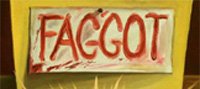
Artistically, I agree with Rev. Irene that we have not fully incorporated the reasons behind Jesus' crucifixion, which I attempted to articulate in my faggot crucifxion:

Look at the word FAGGOT on the cross. You could substitute the word NIGGER, JEW BOY, HONKIE, REDNECK or BITCH—it all means the same. Anytime anyone rises up in condemnation, hatred or violence against another, Christ is [once again] crucified.

I chose the word FAGGOT because today, gays are socially-acceptable and religiously-justifiable targets for hate. And, just like gays, Jesus was made a hate target in his time because he dared to be different, to tell his understanding of the truth even though his words and his position defied the religious establishment.

Who thinks the placard that bore the phrase, King of the Jews, upon the cross at Calvary was anything but a mockery? Who now dares to mock another child of God as a faggot? What justice permits the vilification and segregation of gays as less than equal citizens so deplorably perpetrated in the name of God? Is such an action an act of love or a reaction to fear? A rising chorus within the psychiatric, psychological, and sociological communities plus some religious denominations have concluded that irrational fear belies such behavior.

In 1993, I completed the crucifixion painting as the Clinton Administration capitulated to congressional homophobes in declaring "Don't Ask, Don't Tell" apartheid of gays in the military. I did not realize the artwork prophesied bloodier scenarios. Rev. Monroe describes a year of "haterati" at its ugliest in 1998. An African-American boy named Emmett Till was lynched, James Byrd Jr. was heinously murdered in East Texas, and gay Matthew Shepard was beaten and tied to a wooden fence, a "cross" of sorts where he was left to die--all hate crimes due to what I would describe as a pervasive culture of violence and bigotry aimed at the Other, the minority. Other examples abound from the 1990s to present, from here in the U.S. to the prisons of Abu Ghraib, Camp Bucca, and elsewhere in Iraq. Also...

During the summer months of 1998, the country was hit with the explosion of "ex-gay" ministry ads that appeared in major newspapers like The New York Times, The Washington Post, and USA Today. The ads were sponsored by a coalition of 15 right-wing Christian organizations calling all lesbian, gay, bisexual and transgender people to convert to heterosexuality.

Let me offer right now use of my faggot crucifixion to any organization who would like to reproduce it on a billboard or in an ad to challenge and protest the misuse of Jesus' teaching. Let the message reflect, they know not what they do but we will no longer tolerate bigotry masquerading as God's justice!

Not once did Christ condemn his gay brothers and sisters and perhaps he had a secret in living the down low. The Pauline text so often quoted to justify the alleged sin of man-on-man sex is hotly debated, yet are we to believe that lesbianism is OK? Ha! Few laypeople understand that scribes occasionally altered Scriptures to fit a prevalent religious bias as was done to limit women's roles in the church. Furthermore, we do not have the original manuscripts. Yes, that's right. Biblical textual scholars tell us we do not have one original manuscript of the Gospels. Instead, we have thousands of derivatives and each differ one from another. So much for the inerrant Word of God. What folly it is to take the Bible literally. And yet, Jesus' ministry and his teachings we can fully understand with a few words--love, forgiveness, compassion, and treating each other respectfully--which uplifts and redeems while a bloodshed theology, as Rev. Irene describes it, denigrates:

For those of us on the margins, a Christology mounted on the belief that "Jesus died on the cross for our sins" instead of "Jesus died on the cross because of our sins" not only deifies Jesus as the suffering servant, but it also ritualizes suffering as redemptive. While suffering points to the need for redemption, suffering in and of itself is not redemptive, and it does not always correlate to one's sinfulness. For example, the belief that undeserved suffering is endured by faith, and that it has a morally educative component to it makes the powerful insensitive to the suffering of others and it forces the less powerful to be complacent to their suffering - therefore, maintaining the status quo.

Jesus' suffering on the cross should never be seen as redemptive any more than the suffering of African-American men dangling from trees in the South during Jim Crow America. The lynchings of African-American men were never as restitution for the sins of the Ku Klux Klan, but were, instead, because of their sins that went, for decades, unaccounted for (until the 1951 Federal Anti-Lynching Act was passed). In other words, Jesus' death on the cross and the lynching of African-American are synonymous experiences.

As a deeply controversial icon in Christian liberation theologies for many feminists, womanists, African Americans, and lesbian, gay, bisexual and transgender people, the cross is the locus of redemption insofar as it serves as a lens to critically examine and make the connections between the abuses of power and institutions of domination that brought about the suffering Jesus endured during his time to the abuses of power and institutions of domination that brings about the suffering which women, people of color and sexual minorities are enduring in our present day.

When suffering is understood as an ongoing cycle of abuse that goes on unexamined and unaccounted for, we can then begin to see its manifestation in systems of racism, sexism, classism and heterosexism in our everyday lives. With a new understanding about suffering and how it victimizes the innocent and its aborts the Christian mission of inclusiveness, Jesus' death at Calvary invites a different hermeneutic than its classically held one.

Lesbian, gay, bisexual and transgender people suffer because of well-intended heterosexual Christians' unexamined and unaccounted for acts of homophobia. When these Christians say they love us as sinners, but hate our supposed sin, they are maintaining an unexamined and unaccounted for cycle of spiritual abuse.

Many Christians do not realize that with the classical view of the cross held by many conservatives in their denominations as the exaltation of Jesus as male, Jesus as white, and Jesus as heterosexual, this view not only disinvites the many faces of God that should appear on the cross with Jesus, but it also disinvites solidarity among diverse groups of people who do suffer.

Yes, a different hermeneutic is exactly the need of the hour. To mature spiritually and morally, to progress as a fruitful nation and a beacon for democracy, we must no longer excuse the Dobsons, the Falwells, and the erroneous proposition, to paraphrase Monroe, that Jesus died for our sins when he was crucified because of sin. Therein lies redemption in not only accounting for racism, sexism, homophobia, xenophobia, and any -ism or phobia that excludes one member from the family of humanity, but calling those to account for repeating the sin and promoting it as if it were the truth.

UPDATE: Matt Comer really gets what the painting of The Crucifixion of Christ is about:

Because this message is so strong, it transcends lines of faith and lines of belief. Whatever you do to “the least” of our world’s family, you do to God… and you do to Jesus. If you aren’t the religious type, the message is similar: Whatever you do to “the least” of our world’s family, you do to someone else… for each person is inextricably bound to another; we are all interconnected and interdependent upon each other. When one is hurt, all are hurt. As Wilbur depended on Charlotte and her web, we all depend on each other for life, for joy, for happiness & survival… a huge web of humanity.

Whatever you do to “the least,” you do also to Christ. This painting is such a perfect portrayal of this teaching.

Saturday, July 08, 2006

Did Jesus live the down low?

Rev. Irene Monroe at The Witness blew me away with her provocative and insightful July 3, 2006, column, Church's Code Keeps Jesus on the "Down Low":

For many of us who have always cast a suspicious eye on why biblical scholars, theologians and ministers do not have a clue as to who the historical Jesus was, Dan Brown's bestseller and now blockbuster movie, The Da Vinci Code, sheds an illuminating light onto the hysteria that maintains the mystery.

And the mystery is that there has always been an open secret about Jesus' sexuality that not only attacks the pillars of Christianity, but also profoundly plays into the oppression that women as well as lesbian, gay, bisexual, transgender and queer people face today in both church and society.

And that open secret about Jesus' sexuality -- along with the suggestions that he was gay, married, or both, if Jesus was on the "down low" -- point to the issues we are wrestling with today in what conservatives call the "cultural war," namely the institution of marriage, women in the church, and gay clergy. The hysteria surrounding those issues creates the perfect climate for stories about secret texts emerging from centuries-old closets and church authorities trying desperately to keep the lid over the "truth about Jesus."

However, the debate about Jesus' sexuality takes him from his mother's womb to his tomb. The Christian depiction of Jesus as that of a lifelong virgin who had no sexual desire and who never engaged in sexual intercourse raises anyone's suspicion, when Jesus' traveling with unattached (and therefore "loose") women and with at least twelve men -- the law of averages would say that at least one out of the bunch was gay -- made his scandalous band the subject of a great deal of winking and nudging around ancient Palestine. Of course, given the compulsory heterosexuality in ancient Palestine, a gay Jesus would have been forced to be on the "down low."

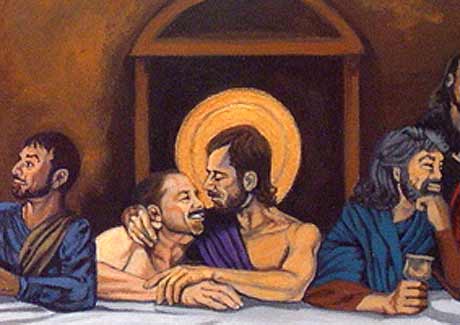
Yup, I couldn't agree more. The de-sexualizing of Jesus caused me to delve into textual criticism, and obviously through my art, I've speculated about a queer Jesus as have others. Rev. Monroe goes on to articulate more fully something that has bothered me for decades and moved me to undertake the subject in oil paint.

Ever notice how lesbians are kewl (a straight guy's wet dream is to get it on with lesbians, right?) but gay guys cause gnashing of the teeth particularly by straight men? I've thought gay guy bias contained an unspoken patriarchal prejudice against the feminine, and historically in usurping the Goddess with a father god, the sacred feminine. Monroe writes (with emphasis):

While homophobia in today's Christian churches is antithetical to the gospel proclaimed by the early Church, so too is the denigration of the sacred feminine.

It would have been highly unusual and very scandalous, given Jewish marital customs, for Jesus not to be married; normally he would have been betrothed and married long before he became an itinerant preacher and called both male and female disciples. And just as any good Jew in Jesus' culture (aside from a few fringe sects like the one that produced the Dead Sea Scrolls) would have obeyed the command in Genesis to "be fruitful and multiply" by having children, any "real man" in Jewish or Roman circles would have shown his masculinity by penetration. Whatever Jesus did or didn't do sexually, his reported failure to marry and have children would have made him, in the eyes of his culture, Queer, unfruitful and feminized.

But Jesus was unashamed to tap into the forbidden zone -- his feminine side. The sacred feminine is not only the life force tied to women's ability to produce new life, but is also the power of the erotic that African-American lesbian poet Audre Lorde depicted as "a source within each of us that lies in a deeply female and spiritual plane, firmly rooted in the power of our unexpressed or unrecognized feeling."

Our sexualities are the expressions of who we are with and in our bodies. They are a language and a means to communicate our spiritual need for intimate communion -- both human and divine. They are our self-understanding through which we experience the world.

However, the hysteria that surrounds Jesus' sexuality forces us all to see the walls of partition erected in our society, in our churches, and in our families that prohibit us from living freely in our bodies and force some of us on the "down low."

And these walls not only contribute to the false socialization of who we are as male and female -- they also contribute to the false spiritualization of who we are as the body of Christ.

What powerful words Monroe writes. Recently, elaborating on the idea of the sacred feminine, I dared to paint a Second Coming oil that embraces the return of a female messiah in the form of a blue pasture rose heralded by a way-showing Christ. Optimistically, I envision a future where the sacred feminine reemerges, and in tandem with the sacred masculine, gives birth to another renaissance, another Age of Enlightenment, and a restoration of balance so sorely needed on our planet. Ironically, Mother Earth and the threat of global warming may spark this necessary correction if we as species intend to flourish. Perhaps I'm foreseeing a vision that's decades or centuries away but I am encouraged to read such inspired words from Rev. Irene Monroe that identify the crux of the issue, the false socialization of who we are as male and female and ultimately a false spiritualization.

If Christians and others such as I accept the belief that we were created in the image of the divine, and that undeniably, we are sexual beings with biologically-induced minority and majority traits, inevitably we must resolve the full spectrum of sexuality and spirituality or continue a compartmentalization that robs us of our wholeness and our holiness. Let the transformative integration accelerate for I intuit that is the evolutionary force presently at work. The emergence of a politically-powerful Religious Right so hell-bent in attempting to subvert feminism, gay equality, and control what all of us do in our bedrooms and the personal decisions we make with our physicians tells me that we have embarked upon the road to recovery and an awakening. Adversity in the form of repression, oppression, and suppression has its purpose in propelling us forward, thank God! In time, these obstacles, too, shall pass.

IMAGES: From top to bottom, Judas Kiss, a cropped close-up of an acrylic study for The Last Supper, and The Raped Virgin.

UPDATE: Seems that I have joined the clan of the Fey Women in subverting necrophilia. Well, I was certainly born to be Wild. Ha!