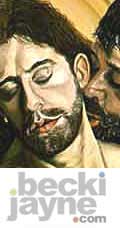
Time for fine art. A painting I would love to have in my collection, Black Madonna - Mitochondrial Eve by artist David Hewson.
The inspiring painting is comprised of 24 kt. water gilt, blue, green, black, red bole (clay), oil on wood measuring 29 1/2" x 20".
A larger image--worth the click for the stunning details-- is here at the artist's website.
I've scrutinized the painting intensely in person and the pixel representation online just doesn't compare to the original.
Absolutely magnificent.
I'm also partial to Devotional, another masterful painting.
You can find Hewson's art at JHS Gallery in Taos, NM, a wonderful gallery where I've exhibited my work.
A few more examples of David's art at JHS Gallery available here along with his education and exhibition history.
If you visit Taos, carve out some time to see the incredible artworks on display at the gallery. You won't be disappointed.
Friday, June 06, 2008
Artist spotlight


Friday, March 21, 2008
Second Coming: Return of the Goddess

Oil on canvas, 16”w X 20”h. Prints available here.
The vernal equinox, Ostara, a time for Eostara observances when the hours of daylight and night come into balance, seemed like an appropriate opportunity to explore the creation of a new story, a visual narrative based an old Christian myth that I long ago shed.
I'm taking a break from political preoccupations and celebrating the return of the Goddess with a different interpretation of what has been popularly known as the Second Coming.
A vast majority of Christians believe in a Second Coming of Jesus, some sort of Apocalypse, an Armageddon, a Rapture that will transpire in the near future. For millennia, this melodramatic myth has persisted yet the planet continues. Life goes on despite great catastrophes that have decimated wildlife, turned seas into deserts, split continents, and driven species to extinction over the course of billions of years. And yet Earth survives. Life moves on.
Has anyone thought that these disasters may be natural occurrences and part of a cycle of correction and rejuvenation? Ever notice how a burnt forest springs back to life more vibrantly after a fire? If our civilization continues at its present pace, ignoring the need to exist in harmony with nature, deaf to the trumpet to change behavior and confront the effects of global warming, we may indeed face an irreversible planetary crisis. Worse case scenario: The human species may not survive as we know it. Evolve? I pray so.
In the painting of The Second Coming: Return of the Goddess, I call for a return to balance, a spiritual correction that heralds the arrival of a female messiah in the form of a blue pasture rose symbolic of Holy Mother, Goddess, the sacred feminine. She has been subverted for far too long and we need her power to balance our male-dominated civilization, its preoccupation with achievement, colonization, and conquest with little regard for Mother Earth and life. The drive for progress has gotten out of kilter. Something's missing. What is it? I dare to say it is the other half of our divinity, our sacred feminine that's been disowned by both men and women.
To atone after tens of thousands of years of male domination, the way-showing Christ--the masculine aspect of divinity--calls forth and welcomes the return of the sacred feminine in the picture above. Together, the balancing complement of masculine and feminine spirituality heralds the dawning of a New Age, a transformation that restores heaven on earth in tune with all life, mind, body, and spirit.
When I hear End of Days or End Times, I want to say, good-bye and good riddance to out-dated patriarchal ways. I think of new beginnings, a time to balance, a time for correction, and a time for transformation culminated in a Second Coming that transcends and inspires. I think of the return of the Goddess--not in replacing God--but in Them joining together, equal at last.
Let it be so is my prayer for this day of equal light and dark.
IMAGE: For a larger version of the painting, click here and then click on the image for it to enlarge.Sunday, March 16, 2008
Lambda Literary Awards
 The 20th Annual Lambda Literary Awards nominated my friend Kittredge Cherry as a finalist in the LGBT Arts and Culture category for her breakthrough book, Art That Dares. I'm tickled for Kitt! She deserves the recognition for her hard work in creating a history-making art book.
You can read a summary about the book at Cherry's Jesus In Love website. I've typed the beginning grafs from the Introduction (pg. 7) of my personal copy signed by Kitt to give you a flavor of what's inside:
Two dramatic new visions are coming into consciousness: the gay Jesus and the woman Christ. They break gender rules and gender roles. Their very presence stirs controversy. These radically new Christ figures embody and empower people who are left out when Jesus is shown as a straight man. They can free the minds of everyone who sees them.
Artists who dare to show Christ as gay or female have had their work destroyed--if they can find a way to exhibit it at all. Now for the first time these beautiful, powerful, sometimes shocking images are gathered together for all to see.
Art That Dares features the work of eleven brave, visionary artists who portray the gay Jesus, the woman Christ, and more. Here they tell the stories behind the images, including the controversies that erupted when the art was exhibited. In some cases the artists faced censorship, hate mail, violence, death threats, and/or vandalism that destroyed their work. Many were accused of blasphemy. Religious freedom clashed with freedom of expression, raising important legal issues. The most virulent opposition came from the religious right, but some were also criticized by feminists and queers for being too Christian.
The paintings, photographs, and sculpture selected for Art That Dares were done over the last thirty years by a diverse group of artists. Most work was done independently, in isolation from the others. Each arrived at the revolutionary images in a unique way. They run the gamut from well established to emerging artists. They are women and men of various races and ethnicities who come from both the United States and Europe. They are among the best of a growing number of artists all over the world who do queer or female Christ figures (Comparable images from Africa and Australia could not be included due to limited resources.)
The artists in this book stand both inside and outside the institutional church. Their religious backgrounds include Buddhism and Judaism as well as Christianity. Some still claim those traditions, while others decline to label their current spirituality. A few hold official church positions. All tried to portray Jesus in a way that honors his life and teachings. The profiles in Art That Dares are based on the author's interviews with the artists, their written statements, and/or news reports.
Full disclosure: I'm one of the "daring" artists in her book:
Jill Ansell
F. Douglas Blanchard
Alex Donis
Becki Jayne Harrelson
Robert Lentz
Janet McKenzie
William Hart McNichols
Elisabeth Ohlson Wallin
Edwina Sandys
Gary Speziale
Sandra Yagi
At Amazon, you can "look inside" and read an excerpt of Kitt Cherry's enchanting prose with a historical bent that hopefully you'll find as fascinating, inspiring, and educational as I do.
I'm crossing my fingers that when the Lambda presenter opens the envelope during the Lambda Literary Awards ceremony in West Hollywood, May 29, the announcement, "And the winner is..." will be followed by "Kittredge Cherry."
POSTSCRIPT: Reading the customer reviews of the book at Amazon one can understand why Kitt was nominated as a finalist for a Lambda Literary Award.
Friday, March 14, 2008
13 essays on Christian mythology and taboos
As another Easter approaches, I'm breaking from tradition and addressing taboos. Isn't that unsurprising! I've never been one for orthodox thought. Politically, I advocate the separation of church and state, for government that's impartial, neutral, that doesn't favor one belief over another, and fully respects those who don't believe in a Creator at all.
Spiritually, I find inspiration in nature, in people, in art, in music, in the expanding universe, and in a diversity of sacred texts. But I won't deny the influence of Christianity in the world--good and bad--or its patriarchal roots. So I tend to delve into its mythology. At the risk of getting flamed, I'll venture to crash some taboos with this post.
From The RealSpiel archives, 13 essays on Christian mythology and its impact on politics and culture.
The Passion of Christ for today
Why glorify the death and suffering of Jesus? If we explore the reasons for Christ's crucifixion and chose to change the "systems of oppression that brought about his demise, violence against marginalized people would cease to exist."
Did Jesus live the down low?
It's entirely possible that Jesus was a married, closeted gay man. But the bigger issue is homophobia in today's Church, the false socialization of who we are as male and female, and ultimately the challenge is to peel away a false spiritualization.
Biblical sexism and vagina resentment
The role of women was liberated by Christ's egalitarian teachings but the Bible has been edited and used as a patriarchal tool to oppress the feminine.
Armageddon: Bible literalists got it wrong
A majority of Americans believe in The Rapture based on a Bible that's fraught with errors. A footnote to copyists in the Book of Revelations has been interpreted to heed the texts as if they were the literal word of God.
The Bible is not the source
A woman's responsibility is to listen to her Inner Source--not to the Bible, not to the alleged "headship" of men, not to a patriarchal church with an ax to grind. Women have equal access to the Creator, the Source of All Life, for divine guidance. Looking to men for women's roles in life, church, and family, is asking the wrong source.
Angelic lesbian, one of RealSpiel's most popular
Why don't angels have genitals? Who stripped them of sexuality? I suppose Christian orthodoxy, which divides sexuality from spirituality and promotes the idea of a celibate Christ, offers the main reason for the absence of angelic sexuality. In my belief system, there's a guardian angel for everybody--gays, lesbians, bisexuals, asexuals, transsexuals, transgendered people, hermaphrodites--everyone and every creature.
The Bible as fountainhead of sexism: money, lesbian power and visions
Guest columnist Genet offers a lesbian feminist viewpoint into gaining success, money, and power. "It is something every lesbian spiritually alive needs to address -- dollars are a spiritual issue!"
In support of Kittredge Cherry
When Kitt Cherry, author of Jesus In Love, Art That Dares, and At The Cross, was attacked by the conservative Institute on Religion and Democracy for her beliefs in a queer Christ, the right to freedom of religion needed to be defended. Included are factors destroying marriage in America. And it's not the perceived threat of gay marriage.
The crucifixion of Madonna
The Material Girl's mock crucifixion received the scorn of Christian critics. Those who defended free speech of the Danish cartoons that set the Muslim world on fire suddenly went mute. Are western liberal values to be shared or hoarded by the religious right? Of course not.
Mel Gibson, hate speech, and media
"Lately this Republican political era of 'compassionate conservatism' has brought forward an unabashed no-holds-barred attitude when it comes to passionate invective hurled at queers, African-Americans, and Jews." Features The Stoning of the Drag Queen.
The Vatican v. Creationism
Vatican astronomer Guy Consolmagno denounced creationism but Biblical literalist Ken Ham chooses the Genesis story over science.
Richest nation on earth and the most Christian but...
Could have supporting the Iraq War offered a method of penance for American Christians who felt guilty and feared retribution for being so well off when so many people in the world languish in poverty? It's an odd concept but fear and guilt have spawned the most atrocious events in history.
Fateful faithful: "American Theocracy"
On Easter Sunday 2006, a lament for the demise of the separation of church and state and the dangerous influence of Christian evangelical extremists on American politics.
Coming soon to celebrate the spring solstice: The Second Coming: The Return of the Goddess. [Update: Essay is here.] The link to the oil painting available at my artist website is here.
UPDATE: I meant spring equinox. I'm already looking forward to summer, but better to be here now.
Saturday, July 29, 2006
Biblical sexism and vagina resentment
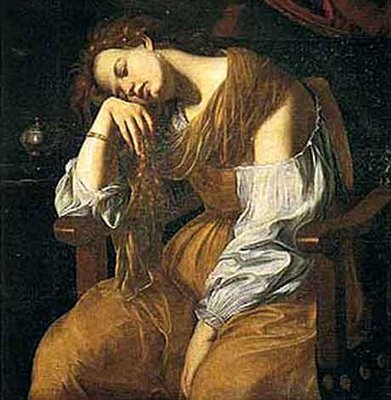
by Artemisia Gentileschi, c. 1621-22, oil on canvas
In the coming weeks, I hope to post a series that will include powerful words, ideas, and criticism from Rev. Irene Monroe, Bishop John Shelby Spong, and others on feminism and lesbian feminism. I'm hopeful that Genet will join me by adding her insights as a voice for the illustrous Lesbianati. This entry, the first of the series, addresses the Bible--the authoritative source of Christianity--as a fountainhead for sexism in America, a previously expressed blog topic I wanted to undertake.
Excerpts from Bart Ehrman's bestseller, Misquoting Jesus illustrate:
How errant Biblical literalism is
The lack of understanding among laypersons that scribes revised manuscripts to reflect their bias, which were then translated into today's modern Bibles
The resultant sexism in the New Testament and
How textual alterations by scribes covered up the prominent roles women held in the early church that were equal to men. One woman, Junia, Paul described as "foremost among the apostles."
Women were integral to Christ's mission and later to the apostle Paul, [pages 178-181, Misquoting Jesus]:
Modern scholars have come to recognize that disputes over the role of women in the early church occurred because women had a role––often a significant and publicly high profile role. Moreover, this was the case from the very beginning, starting with the ministry of Jesus himself. It is true that Jesus's closest followers––the twelve disciples––were all men, as would be expected of a Jewish teacher in first-century Palestine. But our earliest Gospels indicate that Jesus was also accompanied by women on his travels, and that some of these women provided for him and his disciples financially, serving as patrons for his itinerant preaching ministry (see Mark 15:40–51; Luke 8:1–3). Jesus is said to have engaged in public dialogue with women and to have ministered to them in public (Mark 7:24–30; John 4:1–42). In particular, we are told that women accompanied Jesus during his final trip to Jerusalem, where they were present at his crucifixion and where they alone remained faithful to him to the end, when the male disciples had fled (Matt. 27:55; Mark 15:40–41). Most significant of all, each of our Gospels indicates that it was women––Mary Magdalene alone, or with several companions––who discovered his empty tomb and so were the first to know about and testify to Jesus's resurrection from the dead (Matt. 28:1–10; Mark 16:1–8; Luke 23:55–24:10; John 20:1–2).
Why were women so connected to Jesus's ministry when the Jewish tradition at that time treated women as underlings to men?
It is intriguing to ask what it was about Jesus's message that particularly attracted women. Most scholars remained convinced that Jesus proclaimed the coming Kingdom of God, in which there would be no more injustice, suffering, or evil, in which all people, rich and poor, slave and free, men and women, would be on equal footing. This obviously proved particularly attractive as a message of hope to those who in the present age were underprivileged––the poor, the sick, the outcast. And the women.
[...]
But we do not need to wait until the late second century to see that women played a major role in the early Christian churches. We already get a clear sense of this from the earliest Christian writer whose works have survived, the apostle Paul. The Pauline letters of the New Testament provide ample evidence that women held a prominent place in the emerging Christian communities from the earliest of times. We might consider, for example, Paul's letter to the Romans, at the end of which he send greetings to various members of the Roman congregation (chapter 16). Although Paul names more men than women here, it is clear that women were seen as in no way inferior to their male counterparts in the church. Paul mentions Phoebe, for example, who is a deacon (or minister) in the church of Cenchreae, and Paul's own patron, whom he entrusts with the task of carrying his letter to Rome (vv. 1–2). And there is Prisca, who along with her husband, Aquila, is responsible for missionary work among the Gentiles and who supports a Christian congregation in her home (vv. 3–4: notice that she is mentioned first, ahead of her husband). Then there is Mary, a colleague of Paul's who works among the Romans (v. 6); there are also Tryphaena, Tryphosa, and Persis, women whom Paul calls his "co-workers" in the gospel (vv. 6, 12). And there are Julia and the mother of Rufus and the sister of Nereus, all of whom appear to have a high profile in the community (vv 13, 15). Most impressive of all, there is Junia, a woman whom Paul calls "foremost among the apostles" (v. 7). The apostolic band was evidently larger than the list of twelve men with whom most people are familiar.
Women, in short, appear to have played a significant role in the churches of Paul's day. To some extent, this high profile was unusual in the Greco-Roman world. And it may have been rooted, as I have argued, in Jesus's proclamation that in the coming Kingdom there would be equality of men and women. This appears to have been Paul's message as well, as can be seen, for example, in his famous declaration in Galatians:
For as many of you as were baptized into Christ have put on Christ. There is neither Jew nor Greek, neither slave nor free; there is not male and female; for all of you are one in Jesus Christ. (Gal. 3:27–28)
The equality in Christ may have manifested itself in the actual worship services of the Pauline communities. Rather than being silent "hearers of the word," women appear to have been actively involved in the weekly fellowship meetings, participating, for example, by praying and prophesying, much as the men did (I Corinthians 11).
Being unusual in the Greco-Roman world, women playing a significant role created debate and disputes among church leaders (prejudice dies hard) that ultimately impacted Biblical interpreters. Ehrman goes on to write [pages 181, Misquoting Jesus]:
At the same time, to modern interpreters it may appear that Paul did not take his view of the relationship of men and women in Christ to what could be thought of as its logical conclusion. He did require, for example, that when women prayed and prophesied in church they do so with their heads covered, to show that they were "under authority" (I Cor. 11:3–16, esp. v. 10). In other words, Paul did not urge a social revolution in the relationship of men and women––just as he did not urge the abolition of slavery, even though he maintained that in Christ there "is neither slave nor free." Instead he insisted that since "the time is short" (until the coming of the Kingdom), everyone should be content with the roles they had been given, and that no one should seek to change their status––whether slave, free, married, single, male, or female (I Cor. 7:17–24).
My, my, have times changed but not without resistant Biblical literalists using key Scriptures to sustain their bigotry. The world no longer condones slavery although some Christian congregations attempted to justify the slavocracy of the ante-bellum South. Politically and culturally, through the misuse of an errant religious tradition, a Jim Crow hegemony affirmed that people of color were inferior to whites and should be segregated, which excused discrimination against them.
Not until the civil rights movement of the 1960s did legal and cultural racist constructs recede although sadly we can still witness the legacy of America's racism. Yet, under the emergence of the Religious Right, women face formidable challenges in overcoming obstacles to reproductive health, financial parity, autonomy, and in avoiding the epidemic of rape and domestic violence. For an insightful look into the war on women at The Nation, read Martha Nussbaum's review of Catherine A. MacKinnon's book, Are Women Human? Add another book to my wishlist.
The patriarchy still remains King of the Hill, and in my opinion, anti-feminist bias rooted in a persistence of an errant Christian tradition insidiously underpins an unspoken prejudice--in some cases, an explicit calling--that women submit to men.
Ehrman elaborated about the divergent role of women in ancient Christianity that ultimately resolved in a subversion of the sacred feminine [pages 181-182, MJ] with my emphasis added:
At best, then, this can be seen as an ambivalent attitude toward the role of women: they were equal in Christ and were allowed to participate in the life of the community, but as women, not as men (they were, for example, not to remove their veils and so appear as men, without an "authority" on their head). This ambivalence on Paul's part had an interesting effect on the role of women in the churches after his day. In some churches it was the equality in Christ that was emphasized; in others it was the need for women to remain subservient to men. And so in some churches women played very important, leadership roles; in others, their roles were diminished and their voices quieted. Reading later documents associated with Paul's churches, after his death, we can see that disputes arose about the roles women should play; eventually there came an effort to suppress the role of women in churches altogether.
This becomes evident in a letter that was written in Paul's name. Scholars today are by and large convinced that I Timothy was not written by Paul but by one of his later, second-generation followers.3 Here, in one of the (in)famous passages dealing with women in the New Testament, we are told that women must not be allowed to teach men because they were created inferior, as indicated by God himself in the Law; God created Eve second, for the sake of the man; and a woman (related to Eve) must not therefore lord it over a man (related to Adam) through her teaching. Furthermore, according to this author, everyone knows what happens when a women does assume the role of teacher: she is easily duped (by the devil) and leads the man astray. So, women are to stay at home and maintain the virtues appropriate to women, bearing children for their husbands and preserving their modesty. As the passage itself reads:
Let a woman learn in silence with full submission. I permit no woman to teach or to have authority over a man; she is to keep silent. For Adam was formed first, then Eve; and Adam was not deceived, but the woman was deceived and became a transgressor. Yet she will be saved through childbearing, provided they continue in faith and love and holiness, with modesty. (I Tim. 2:11–15).
This seems a long way from Paul's view that "in Christ there is . . . not male and female." As we move into the second century, the battle lines appear clearly drawn. There are some Christian communities that stress the importance of women and allow them to play significant roles in the church, and there are others that believe women must be silent and subservient to the men of the community.
The scribes who were copying the texts that later became scripture were obviously involved in these debates. And on occasion the debates made an impact on the text being copied, as passages were changed to reflect the views of the scribes who were reproducing them. In almost every instance in which a change of this sort occurs, the text is changed in order to limit the role of women and to minimize their importance in the Christian movement.
Now to examine the anti-feminist scriptural alterations that scribes made to diminish women (with my emphasis added) from Bart Ehrman [pages 183-184, MJ]:
One of the most important passages in the contemporary discussion of the role of women in the church is found in I Corinthians 14. As represented in most of our modern English translations, the passages reads as follows.
33 For God is not a God of confusion but one of peace. As in all the churches of the saints, 34 let the women keep silent. For it is not permitted for them to speak, but to be in subjection, just as the law says. 35 But if they wish to learn anything, let them ask their own husbands at home. For it is shameful for a woman to speak in church. 36 What! Did the word go forth only from you, or has it reached you alone?
The passage appears to be a clear and straightforward injunction for women not to speak (let alone teach!) in the church, very much like the passage from I Timothy 2. As we have seen, however, most scholars are convinced that Paul did not write the I Timothy passage, because it occurs in a letter that appears to have been written instead by a second-generation follower of Paul in his name. No one doubts, however, that Paul wrote I Corinthians. But there are doubts about this passage. For as it turns out, the verses in question (vv. 34–35) are shuffled around in some of our important textual witnesses. In three Greek manuscripts and a couple of Latin witnesses, they are found not here, after verse 33, but later, after verse 40. That has led some scholars to surmise that the verses were not written by Paul but originated as a kind of marginal note added by a scribe, possibly under the influence of I Timothy 2. The note was then inserted in different places of the text by various scribes––some placing the note after verse 33 and others inserting it after verse 40. There are good reasons for thinking that Paul did not originally write these verses. For one thing, they do not fit well into their immediate context. In this part of I Corinthians 14, Paul is addressing the issue of prophecy in the church, and is giving instructions to Christian prophets concerning how they are to behave during the Christian services of worship. This is the theme of verses 26–33, and it is the theme again of verses 36–40. If one removes verses 34–35 from their context, the passage seems to flow seamlessly as a discussion of the role of Christian prophets. The discussion of women appears, then, as intrusive in its immediate context, breaking into the instructions that Paul is giving about a different matter.
Not only do the verses seem intrusive in the context of chapter 14, they also appear anomalous with what Paul explicitly says elsewhere in I Corinthians. For earlier in the book, as we have already noticed, Paul gives instructions to women speaking in the church: according to chapter 11, when they pray and prophesy––activities that were always done aloud in the Christian services of worship––they are to be sure to wear veils on their heads (11:2–16). In this passage, which no one doubts Paul wrote, it is clear that Paul understands that women both can and do speak in church. In the disputed passage of chapter 14, however, it is equally clear that "Paul" forbids women from speaking at all. It is difficult to reconcile these two views––either Paul allowed women to speak (with covered heads, chapter 11) or not (chapter 14). As it seems unreasonable to think that Paul would flat out contradict himself within the short space of three chapters, it appears that the verses in question do not derive from Paul.
And so on the basis of a combination of evidence––several manuscripts that shuffle the verses around, the immediate literary context, and the context within I Corinthians as a whole––it appears that Paul did not write I Cor. 14:34–35. One would have to assume, then, that these verses are a scribal alteration of the text, originally made, perhaps, as a marginal note and then eventually, at an early stage of the copying of I Corinthians, placed it in the text itself. The alteration was no doubt made by a scribe who was concerned to emphasize that women should have no public role in the church, that they should be silent and subservient to their husbands. This view then came to be incorporated into the text itself, by means of a textual alteration.4
On page 185, Ehrman describes the woman Junia who was "foremost among the apostles" but she was magically transformed into a man (with emphasis):
We might consider briefly several other textual changes of a similar sort. One occurs in a passage I have already mentioned, Romans 16, in which Paul speaks of a woman, Junia, and a man who was presumably her husband, Andronicus, both of whom he calls "foremost among the apostles" (v. 7). This is a significant verse, because it is the only place in the New Testament in which a woman is referred to as an apostle. Interpreters have been so impressed by the passage that a large number of them have insisted that it cannot mean what it says, and so they have translated the verse as referring not to a woman named Junia but a man names Junias, who along with his companion Andronicus is praised as an apostle. The problem with this translation is that whereas Junia was a common name for a woman, there is no evidence in the ancient world for "Junias" as a man's name. Paul is referring to a woman named Junia, even though in some modern English Bibles (you may want to check your own!) translators continue to refer to this female apostle as if she were a man named Junias. 5
Some scribes also had difficulty with ascribing apostleship to this otherwise unknown woman, and so made a very slight change in the text to circumvent the problem. In some of our manuscripts, rather than saying, "Greet Andronicus and Junia, my relatives and fellow prisoners, who are foremost among the apostles," the text is now changed so as to be more readily translated: "Greet Andronicus and Junia, my relatives; and also greet my fellow prisoners who are foremost among the apostles." With this textual change, no longer does one need to worry about a woman being cited among the apostolic band of men!
Ha! A quick Bible Gateway search of Romans 16:7 in the New International Version (NIV), the New American Standard Bible (NASB), the Contemporary English Version (CEV), the Worldwide English (New Testament) (WE), the Holman Christian Standard Bible (HCSB), and other versions name Junia the woman as Junias or Junia the man.
In the King James Version (KJV), the New King James Version (NKJV), and other Bible editions, we can read a derivative of the latter alteration that changes the text to eliminate any reference to Junia as among the apostolic band of men.
Again on page 185, Ehrman points out another textual change to reduce women's stature (with emphasis):
A similar change was made by some scribes who copied the book of Acts. In chapter 17 we learn that Paul and his missionary companion Silas spent time in Thessalonica preaching the gospel of Christ to the Jews of the local synagogue. We are told in verse 4 that the pair made some important converts: "And some of them were persuaded and joined with Paul and Silas, as did a great many of the pious Greeks, along with a large number of prominent women."
The idea of women being prominent––let alone prominent converts––was too much for some scribes, and so the text came to be changed in some manuscripts so that we are told: "And some of them were persuaded and joined with Paul and Silas, as did a great many of the pious Greeks, along with a large number of wives of prominent men." Now it is the men who are prominent, not the wives who converted.
Among Paul's companions in the book of Acts were a husband and wife named Aquila and Priscilla; sometimes when they are mentioned, the author gives the wife's name first, as if she had some kind of of special prominence either in the relationship or in the Christian mission (as happens in Rom. 16:3, where she is called Prisca). Not surprisingly, scribes occasionally took umbrage at this sequencing and reversed it, so that the man was given his due by having his name mentioned first: Aquila and Priscilla rather than Priscilla and Aquila. 6
In short, there were debates in the early centuries of the church over the role of women, and on occasion these debates spilled over into the textual transmission of the New Testament itself, as scribes sometimes changed their texts in order to make them coincide more closely with the scribes' own sense of the (limited) role of women in the church.
To this day, we witness the subversion of women in religion. The Vatican continues to ban women from the priesthood. In June 2006, U.S. Episcopalians elected Katharine Jefferts Schori as the first female bishop of the national churches in the worldwide Anglican Communion. What took them so long!? And what mindset and attitude questions why the "choice" of a female bishop complicates the already difficult relations between the American denomination and its fellow Anglicans? Has male resentment over an alpha vagina leeched its poison into our marrow with the diseased thought that women are trouble and less desirable leaders than men? Where's the missing positive, the balance to the bias of a subservient women's role in church and beyond? How have women come to accept second best as if they lived in an Updike world as "house slaves of the A&P?"
I remember clashing with a southern gay gent over the admittance of Shannon Faulkner into the Citadel and I was surprised at anti-feminine bias spouted by an effeminate male. I could have had a more enlightening conversation with a brick wall sans the graffiti smear, "Bi-yotch." How inconvenient for men when women rock the boat with their audacity--demanding that an institution supported by their tax dollars ought to include them! Such a quibble. The whining hurts my ears went the dismissive male harumph.
I'm sure if I dug around I could google up statistics about the state of women's affairs--the assault on contraception, women's health, wage discrepancies, sexual harassment, violent and sex crimes, leisure time, wealth distribution, and positions of power--I could prove that it's still a man's world overlaid with quotes from misogynist prose you can hear on TV and the radio out of the mouths of the Limbaugh punditocracy and religious wacky doodles. I don't accept factoids and artificial rhetoric disguised as a string of pearly wisdom as permanent feminine reality. Yes, we can change the systems that underpin sexism, racism, and all the other hang-ups. The path of adversity, of resistance, the bigger challenge cuts through a landscape of single-issues to the source--the heart and mind that assigns value to men more than women. To transform beliefs, a revolution would entail both one-on-one interactions and collectively as an interlaced unified force. Isn't it time we seriously got to work on healing vagina resentment and the false aggrandizement of penis? Doesn't the error emphasize the flesh over the spirit?
I entitled this post within the context of Biblical sexism but the better frame--now that I have processed my thoughts on this subject and I'm sure more will evolve--is how sexism as male superiority and domination has invaded even our sacred texts in the annihilation of the sacred feminine and women's voices. With a religious authority such as the Bible deposited into the collective mind receptacle, the traditional church has taught the American layperson what the Scriptures were edited to dogmatize. We can understand the powerful influence that these beliefs have had on men's and women's attitudes and the consequential probable reality. Relegated to a secondary place in God's world, trickling down from a Godhead across the land to the tiniest shopping mall berg, women have been defined in society, industries, professions, and politics as less than, not good enough, not as valuable as men. How can we change it? By heightening the awareness of who and what is responsible for the gender gap in a no holds bar riffing of the truth is the first step. Secondly, overhaul the legacy that promotes woman as Adam's Rib, that says Eves derive their source from Adams, that Eves aren't a primary first-born gender but a sex created from Man in not being deemed worthy to spring directly from God. Surely, no one would suggest that God isn't omnipotent enough to fashion two unique primogenital sexes endowed with divine power at the same time?
In political circles, executive boardrooms, and polite gatherings, no one dares to assert that women aren't men's equal and gals were made for guys unless one is rude, arrogant, or spoiling for a lawsuit. The need to appear civilized, therefore, has shifted sexists to adopt an underground of code words--radical feminism, feminazis, androgynous society, social experimentation, political correctness, academic intolerance, to name a few terms that target stereotypical female behavior.
I hope brave women and men of all ilks--religious and secular--will compassionately and fairly examine the facts to no longer accept a false perception and a greediness of one's gender turf to continue to forge divergent realities for the sexes. Ha! Perhaps in our examination of the institutional face of religion and the stories of our culture, we ought to reverse the paradigm to expose the supposition behind the lie: Why are men inferior to women?
It's time, as Rev. Irene wrote, for a different hermeneutic than [the] classically held one, a faith in which God created the human genders simultaneously and both in divinity. It's time for new stories. Scriptures contain a male bias constructed in the past that's been perpetrated generation to generation for centuries. Why not listen anew to the Living Presence? For there's no better Source for the believer of today than the kingdom of God at hand, alive within us.
FOR THE RECORD: I'm a strong advocate of the separation of church and state. My religion nor should any other religion be imposed upon anyone. Funny how we hear about free will, and then those who espouse it, work tirelessly to end it. God save us from your people.
Saturday, July 08, 2006
Did Jesus live the down low?

Rev. Irene Monroe at The Witness blew me away with her provocative and insightful July 3, 2006, column, Church's Code Keeps Jesus on the "Down Low":
For many of us who have always cast a suspicious eye on why biblical scholars, theologians and ministers do not have a clue as to who the historical Jesus was, Dan Brown's bestseller and now blockbuster movie, The Da Vinci Code, sheds an illuminating light onto the hysteria that maintains the mystery.
And the mystery is that there has always been an open secret about Jesus' sexuality that not only attacks the pillars of Christianity, but also profoundly plays into the oppression that women as well as lesbian, gay, bisexual, transgender and queer people face today in both church and society.
And that open secret about Jesus' sexuality -- along with the suggestions that he was gay, married, or both, if Jesus was on the "down low" -- point to the issues we are wrestling with today in what conservatives call the "cultural war," namely the institution of marriage, women in the church, and gay clergy. The hysteria surrounding those issues creates the perfect climate for stories about secret texts emerging from centuries-old closets and church authorities trying desperately to keep the lid over the "truth about Jesus."
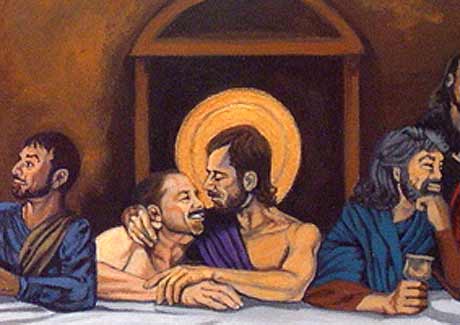
However, the debate about Jesus' sexuality takes him from his mother's womb to his tomb. The Christian depiction of Jesus as that of a lifelong virgin who had no sexual desire and who never engaged in sexual intercourse raises anyone's suspicion, when Jesus' traveling with unattached (and therefore "loose") women and with at least twelve men -- the law of averages would say that at least one out of the bunch was gay -- made his scandalous band the subject of a great deal of winking and nudging around ancient Palestine. Of course, given the compulsory heterosexuality in ancient Palestine, a gay Jesus would have been forced to be on the "down low."
Yup, I couldn't agree more. The de-sexualizing of Jesus caused me to delve into textual criticism, and obviously through my art, I've speculated about a queer Jesus as have others. Rev. Monroe goes on to articulate more fully something that has bothered me for decades and moved me to undertake the subject in oil paint.
Ever notice how lesbians are kewl (a straight guy's wet dream is to get it on with lesbians, right?) but gay guys cause gnashing of the teeth particularly by straight men? I've thought gay guy bias contained an unspoken patriarchal prejudice against the feminine, and historically in usurping the Goddess with a father god, the sacred feminine. Monroe writes (with emphasis):
While homophobia in today's Christian churches is antithetical to the gospel proclaimed by the early Church, so too is the denigration of the sacred feminine.
It would have been highly unusual and very scandalous, given Jewish marital customs, for Jesus not to be married; normally he would have been betrothed and married long before he became an itinerant preacher and called both male and female disciples. And just as any good Jew in Jesus' culture (aside from a few fringe sects like the one that produced the Dead Sea Scrolls) would have obeyed the command in Genesis to "be fruitful and multiply" by having children, any "real man" in Jewish or Roman circles would have shown his masculinity by penetration. Whatever Jesus did or didn't do sexually, his reported failure to marry and have children would have made him, in the eyes of his culture, Queer, unfruitful and feminized.
But Jesus was unashamed to tap into the forbidden zone -- his feminine side. The sacred feminine is not only the life force tied to women's ability to produce new life, but is also the power of the erotic that African-American lesbian poet Audre Lorde depicted as "a source within each of us that lies in a deeply female and spiritual plane, firmly rooted in the power of our unexpressed or unrecognized feeling."
Our sexualities are the expressions of who we are with and in our bodies. They are a language and a means to communicate our spiritual need for intimate communion -- both human and divine. They are our self-understanding through which we experience the world.
However, the hysteria that surrounds Jesus' sexuality forces us all to see the walls of partition erected in our society, in our churches, and in our families that prohibit us from living freely in our bodies and force some of us on the "down low."
And these walls not only contribute to the false socialization of who we are as male and female -- they also contribute to the false spiritualization of who we are as the body of Christ.
What powerful words Monroe writes. Recently, elaborating on the idea of the sacred feminine, I dared to paint a Second Coming oil that embraces the return of a female messiah in the form of a blue pasture rose heralded by a way-showing Christ. Optimistically, I envision a future where the sacred feminine reemerges, and in tandem with the sacred masculine, gives birth to another renaissance, another Age of Enlightenment, and a restoration of balance so sorely needed on our planet. Ironically, Mother Earth and the threat of global warming may spark this necessary correction if we as species intend to flourish. Perhaps I'm foreseeing a vision that's decades or centuries away but I am encouraged to read such inspired words from Rev. Irene Monroe that identify the crux of the issue, the false socialization of who we are as male and female and ultimately a false spiritualization.
If Christians and others such as I accept the belief that we were created in the image of the divine, and that undeniably, we are sexual beings with biologically-induced minority and majority traits, inevitably we must resolve the full spectrum of sexuality and spirituality or continue a compartmentalization that robs us of our wholeness and our holiness. Let the transformative integration accelerate for I intuit that is the evolutionary force presently at work. The emergence of a politically-powerful Religious Right so hell-bent in attempting to subvert feminism, gay equality, and control what all of us do in our bedrooms and the personal decisions we make with our physicians tells me that we have embarked upon the road to recovery and an awakening. Adversity in the form of repression, oppression, and suppression has its purpose in propelling us forward, thank God! In time, these obstacles, too, shall pass.
IMAGES: From top to bottom, Judas Kiss, a cropped close-up of an acrylic study for The Last Supper, and The Raped Virgin.
UPDATE: Seems that I have joined the clan of the Fey Women in subverting necrophilia. Well, I was certainly born to be Wild. Ha!