Showing posts with label Art. Show all posts

Sunday, March 16, 2008

Lambda Literary Awards

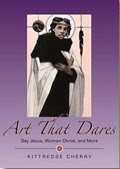
The 20th Annual Lambda Literary Awards nominated my friend Kittredge Cherry as a finalist in the LGBT Arts and Culture category for her breakthrough book, Art That Dares. I'm tickled for Kitt! She deserves the recognition for her hard work in creating a history-making art book.

You can read a summary about the book at Cherry's Jesus In Love website. I've typed the beginning grafs from the Introduction (pg. 7) of my personal copy signed by Kitt to give you a flavor of what's inside:

Two dramatic new visions are coming into consciousness: the gay Jesus and the woman Christ. They break gender rules and gender roles. Their very presence stirs controversy. These radically new Christ figures embody and empower people who are left out when Jesus is shown as a straight man. They can free the minds of everyone who sees them.

Artists who dare to show Christ as gay or female have had their work destroyed--if they can find a way to exhibit it at all. Now for the first time these beautiful, powerful, sometimes shocking images are gathered together for all to see.

Art That Dares features the work of eleven brave, visionary artists who portray the gay Jesus, the woman Christ, and more. Here they tell the stories behind the images, including the controversies that erupted when the art was exhibited. In some cases the artists faced censorship, hate mail, violence, death threats, and/or vandalism that destroyed their work. Many were accused of blasphemy. Religious freedom clashed with freedom of expression, raising important legal issues. The most virulent opposition came from the religious right, but some were also criticized by feminists and queers for being too Christian.

The paintings, photographs, and sculpture selected for Art That Dares were done over the last thirty years by a diverse group of artists. Most work was done independently, in isolation from the others. Each arrived at the revolutionary images in a unique way. They run the gamut from well established to emerging artists. They are women and men of various races and ethnicities who come from both the United States and Europe. They are among the best of a growing number of artists all over the world who do queer or female Christ figures (Comparable images from Africa and Australia could not be included due to limited resources.)

The artists in this book stand both inside and outside the institutional church. Their religious backgrounds include Buddhism and Judaism as well as Christianity. Some still claim those traditions, while others decline to label their current spirituality. A few hold official church positions. All tried to portray Jesus in a way that honors his life and teachings. The profiles in Art That Dares are based on the author's interviews with the artists, their written statements, and/or news reports.

Full disclosure: I'm one of the "daring" artists in her book:

Jill Ansell
F. Douglas Blanchard
Alex Donis
Becki Jayne Harrelson
Robert Lentz
Janet McKenzie
William Hart McNichols
Elisabeth Ohlson Wallin
Edwina Sandys
Gary Speziale
Sandra Yagi

At Amazon, you can "look inside" and read an excerpt of Kitt Cherry's enchanting prose with a historical bent that hopefully you'll find as fascinating, inspiring, and educational as I do.

I'm crossing my fingers that when the Lambda presenter opens the envelope during the Lambda Literary Awards ceremony in West Hollywood, May 29, the announcement, "And the winner is..." will be followed by "Kittredge Cherry."

POSTSCRIPT: Reading the customer reviews of the book at Amazon one can understand why Kitt was nominated as a finalist for a Lambda Literary Award.

Friday, February 22, 2008

Tribute to Artemisia's Judith

What has happened to the women’s movement and in particular, the Lesbianati™? Has everyone traded principle, freedom, and equality for money and security? Of course, I exaggerate when I say everyone but sometimes it seems that too many women have lost their hunger for justice, too busy to act on their convictions or are disenfranchised, demoralized by a national agenda that often excludes them.

We cannot deny that women and lesbians are underpaid. Domestic violence and rape are epidemic in America and LGBT rights have been derailed by the Religious Right’s assault culturally and politically. The problems women face have improved but marginally at the speed of a snail. Even now, with the presidential candidacy of Sen. Hillary Rodham Clinton, we have witnessed blatant misogyny on display in media and politics.

On CNN, National Council of Women's Organizations founder Martha Burk remarked of Clinton's rival, Sen. Barack Obama, "Were he female, put lipstick and long hair on him, I don't think he would be anywhere near the presidency of the United States right now. . . . Women are perceived differently. They get punished for being competent more than men do, because they're seen as too tough, not gentle, not womanly enough. Conversely, men benefit from gender discrimination." She has a point.

Last year, such challenges inspired me to pay homage to a Master painter updated with a modern narrative in a Tribute to Artmesia's Judith.

Enduring discrimination, torture, rape, and sexually harassment, Artemisia Gentileschi (1593–1652/1653) achieved fame as a female artist despite the male-dominated post-Renaissance world. She was a pioneer and one of the world’s greatest Masters. Art historian Mary D. Garrard wrote that Artemisia "has suffered a scholarly neglect that is unthinkable for an artist of her calibre." Indeed! But the patriarchy has under-valued the feminine in art, religion, and all aspects of life for thousands of years. Review 20th century artists and the majority of the names are still male. Artemisia might fare better today but I doubt it.

Historians have thought that Artemisia painted Judith Slaying Holofernes as a cathartic release from the trauma of being sexually harassed and her virginity raped by Agostino Tassi, her art instructor and family friend. In my tribute to Artemisia, I’ve updated the narrative to reflect today’s human condition and create a metaphorical lightning rod for action. Make no mistake…I am not advocating violence. Protest, yes. Violence, never! I consider the sword in the artwork as a symbol for the divine truth that we are all created equal. And taking action to speak the unvarnished, inspired truth will set us free. One doesn't have to believe in God to embrace such notions; they are fundamental to the U.S. Constitution and mental health.

I also modified the Judith figure transforming her into a lesbian, although unless a viewer knows the pink triangle of the pendant hanging around her neck, Judith could be a sister or any woman, a champion for all women. A dark-skinned woman joins her to represent women of color. Together they stand for the female sex, women who have been subverted and disrespected as they allegorically hold down and decapitate America’s patriarchal oppressors.

In the background, a resurrected Christ overshadows a cantilevered bloody-red cross of the male-oriented “suffering” Church to encourage, inspire, and bless the women who are equalizing their situation in life by protesting and thwarting male oppression in whatever form – professionally, religiously, and culturally – to render justice. I daresay, Jesus, who surrounded himself with women and female patrons, calls out, Rise up, Sisters! Come forth, speak the truth, and claim your divine power!

IMAGES: From top to bottom, my 2007 Tribute to Artemisia’s Judith, oil on canvas, 36”w X 48”h; my drawing for the painting, and lastly, Master artist Artemisia Gentileschi's Naples version of Judith Slaying Holofernes, oil on canvas, c. 1612-1613.

Tuesday, May 02, 2006

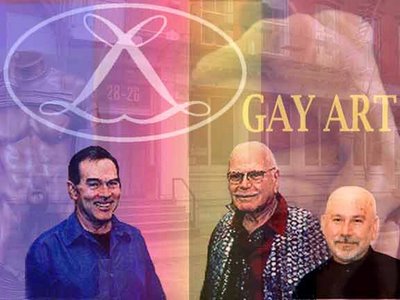
Champions of gay art

L to R: Charles Leslie, Fritz Lohman, and Wayne Snellen.
Featured artists in the above montage, L to R: Douglas Holtquist and Li Ming Shun

Tonight, Leslie-Lohman Gay Arts Foundation opened a new gallery space in Soho, New York, an occurrence that might seem un-extraordinary. But Charles Leslie and Fritz Lohman aren't ordinary. They're pioneers of gay art history and still thriving when others failed. Leslie and Lohman opened the first major gallery during the 1970s exclusively devoted to explicitly gay art after having begun shows at their Prince Street loft the year of the Stonewall riots. An entry at GLBTQ, an encyclopedia of gay, lesbian, bisexual, transgender, and queer culture, quotes Charles Leslie:

"We regard our work as part of the gay liberation movement."

Indeed, they do. Charles W. Leslie and J. Frederick Lohman, ASID, paved the way, liberating gay artists from obscurity when other galleries wouldn't dare show homoerotic or politically-incorrect queer art for fear of offending a right-leaning mainstream or a homophobic backlash. It takes grit and courage especially when you're members of a minority scorned inappropriately with religiously-charged invectives (sodomites!), marginalized, and denied the rights that most Americans take for granted. And Leslie and Lohman did it when the gay liberation movement was initially taking root and long before ground-breaking icons, Rosie, Ellen, and Missy Etheridge, crashed the pink ceiling coming out of the closet publicly. Rosie and Missy were barely teenagers when Charles and Fritz opened their doors at the Leslie/Lohman Gallery on the corner of Broome and Wooster in 1975. Douglas Blair Turnbaugh at GLBTQ wrote of their early history:

Although the Leslie-Lohman gallery did not make money, it was a succès d'estime and inspired others. By 1980 there were six gay art galleries in New York City, creating a new and vibrant social and cultural circuit for an avid gay public. Then the AIDS crisis struck, and in the terror many gay businesses that had celebrated gay sex, particularly baths, bars, and movie houses, closed or were shut down. Among these casualties were art galleries.

By the late 1980s, Leslie and Lohman had reconsidered, with a raised consciousness, the issues of gay art and gay liberation. They decided to address these issues by setting up a foundation, in order to have the same tax-exempt status enjoyed by religious, educational, philanthropic, and other not-for-profit organizations.

In 1990, after relentless work by their lawyers--and homophobic responses challenging the organization's goals and purposes--the Leslie-Lohman Gay Art Foundation came into being. Its name is the first time the word "gay" appeared in the federal government's registry of not-for-profit organizations.

[...]

Since its founding, the foundation has shown the work of 550 artists in more than 200 exhibitions; and its permanent collection has grown to approximately 1,000 pieces, including paintings, sculpture, drawings, and photography.

Examine the list of gay artists whose work has been exhibited at the Leslie-Lohman gallery, click through their exhibition history, and you will find prominent names--Paul Cadmus, Keith Haring, Delmas Howe, Robert Mapplethorpe, Tom of Finland, Wilhilm Von Gloeden, Bruce Weber--to recognize a few. There are so many. Unlike traditional galleries, LLGAF doesn't sell art, acting more as a conduit for artists and collectors (although art is sold during scheduled exhibitions), which helps working artists to survive rather than struggle with the typical 50% to 60% commission that most galleries retain. Such an arrangement keeps artists healthy and art-ing to illustrate that Charles and Fritz put compassionate heart into their visionary efforts.

LLGAF also publishes The Archive, its official newsletter, and its website displays, Milestones: "A Timeline of Gay and Lesbian Artists and History," a comprehensive reference for uninitiated queer culture newbies.

As LLGAF debuted in their new expansive space designed by architect Anthony Pellino in one of New York's oldest cast-iron buildings, the opening gala kicked off, "The Culture of Queer," a tribute to J.B Harter with nine Louisiana artists, and works from Leslie-Lohman's permanent collection. Curated by David S. Rubin from the Contemporary Arts Center in NOLA, the artwork, LLGAF's first traveling exhibition that premiered at CAC, scarcely survived Katrina when the hurricane roared ashore. If you're in NYC, catch the show through Jul. 1 to bolster artists recovering from Katrina and visit a leading gallery and champion of gay art. More LLGAF exhibition schedules and event information are here.

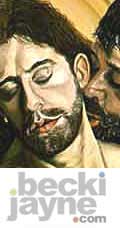
To make a full disclosure since some bloggers have covert agendas and hidden sponsors, I've exhibited at LLGAF twice, showing Judas Kiss in "Vulvavision," 1995, LLGAF's second lesbian group show, and Madonna, Lover & Son in the "Religious Content in Contemporary Lesbian and Gay Art" show in 1998. Naturally, I support LLGAF's mission being a working gay artist and vice versa. If not for the bravery of LLGAF and the Faces of Jesus Gallery (in a Baptist church... wow!), controversial art such as mine and other gay artists might remain only available on the Internet and in publications--venues that can't possibly convey the dynamic impact of viewing the actual artwork.

Props to Charles, Fritz, Wayne Snellen, the director of LLGAF, and the foundation's dauntless staff.

Besides making a tax-deductible contribution to LLGAF, I can't think of a worthier gay culture cause than buying gay art especially during these regressive political times for the sake of GLBT heritage, in support of artists, and perhaps donating art to the LLGAF permanent collection. Consult your tax advisor, but IIRC, donated art to a legit non-profit organization still offers a tax deduction. The tax code discriminates against artist donations but patron donors can deduct the fair market value. And living artists (*cough*) would appreciate the patronage.