Showing posts with label GLBT. Show all posts

Wednesday, October 11, 2006

National Coming Out Day

Pam Spaulding offers a summary of lots of data so click the link. A snip:

October 11 is National Coming Out Day. The theme is "Talk About It."

The big news this year is information that should put fear into the hearts of The Base -- 70% of heterosexual adults now know someone gay.

And -- those with an out gay or lesbian family member raises the typical American's support for full marriage equality by 17 percentage points.

The above results are from two studies being released by HRC, one by Harris Interactive and the other, "'Coming Out' and Americans' Attitudes on Gay Rights," from the Hunter College Center for Sexuality and Public Policy.

Additional findings:
* 92% of self-identified gays said they are out to close friends
* 78% said they are out to their parents
* A majority are out to other people in their lives, including grandparents, cousins, acquaintances and casual friends, and coworkers and colleagues.

Pam's House Blend can always keep you up on LGBT issues so bookmark Pam's site.

Bravo to all the gays and lesbians who are out of the closet!

IMAGE: The arresting graphic of the Statue of Liberty draped in the rainbow flag came from here. C'est fantastique!

Saturday, July 08, 2006

Did Jesus live the down low?

Rev. Irene Monroe at The Witness blew me away with her provocative and insightful July 3, 2006, column, Church's Code Keeps Jesus on the "Down Low":

For many of us who have always cast a suspicious eye on why biblical scholars, theologians and ministers do not have a clue as to who the historical Jesus was, Dan Brown's bestseller and now blockbuster movie, The Da Vinci Code, sheds an illuminating light onto the hysteria that maintains the mystery.

And the mystery is that there has always been an open secret about Jesus' sexuality that not only attacks the pillars of Christianity, but also profoundly plays into the oppression that women as well as lesbian, gay, bisexual, transgender and queer people face today in both church and society.

And that open secret about Jesus' sexuality -- along with the suggestions that he was gay, married, or both, if Jesus was on the "down low" -- point to the issues we are wrestling with today in what conservatives call the "cultural war," namely the institution of marriage, women in the church, and gay clergy. The hysteria surrounding those issues creates the perfect climate for stories about secret texts emerging from centuries-old closets and church authorities trying desperately to keep the lid over the "truth about Jesus."

However, the debate about Jesus' sexuality takes him from his mother's womb to his tomb. The Christian depiction of Jesus as that of a lifelong virgin who had no sexual desire and who never engaged in sexual intercourse raises anyone's suspicion, when Jesus' traveling with unattached (and therefore "loose") women and with at least twelve men -- the law of averages would say that at least one out of the bunch was gay -- made his scandalous band the subject of a great deal of winking and nudging around ancient Palestine. Of course, given the compulsory heterosexuality in ancient Palestine, a gay Jesus would have been forced to be on the "down low."

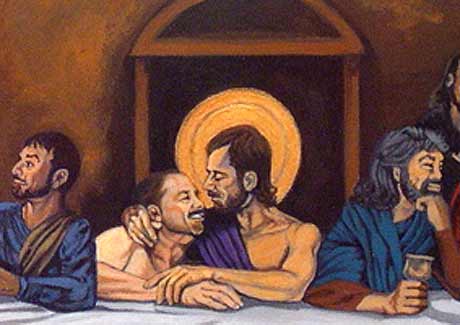
Yup, I couldn't agree more. The de-sexualizing of Jesus caused me to delve into textual criticism, and obviously through my art, I've speculated about a queer Jesus as have others. Rev. Monroe goes on to articulate more fully something that has bothered me for decades and moved me to undertake the subject in oil paint.

Ever notice how lesbians are kewl (a straight guy's wet dream is to get it on with lesbians, right?) but gay guys cause gnashing of the teeth particularly by straight men? I've thought gay guy bias contained an unspoken patriarchal prejudice against the feminine, and historically in usurping the Goddess with a father god, the sacred feminine. Monroe writes (with emphasis):

While homophobia in today's Christian churches is antithetical to the gospel proclaimed by the early Church, so too is the denigration of the sacred feminine.

It would have been highly unusual and very scandalous, given Jewish marital customs, for Jesus not to be married; normally he would have been betrothed and married long before he became an itinerant preacher and called both male and female disciples. And just as any good Jew in Jesus' culture (aside from a few fringe sects like the one that produced the Dead Sea Scrolls) would have obeyed the command in Genesis to "be fruitful and multiply" by having children, any "real man" in Jewish or Roman circles would have shown his masculinity by penetration. Whatever Jesus did or didn't do sexually, his reported failure to marry and have children would have made him, in the eyes of his culture, Queer, unfruitful and feminized.

But Jesus was unashamed to tap into the forbidden zone -- his feminine side. The sacred feminine is not only the life force tied to women's ability to produce new life, but is also the power of the erotic that African-American lesbian poet Audre Lorde depicted as "a source within each of us that lies in a deeply female and spiritual plane, firmly rooted in the power of our unexpressed or unrecognized feeling."

Our sexualities are the expressions of who we are with and in our bodies. They are a language and a means to communicate our spiritual need for intimate communion -- both human and divine. They are our self-understanding through which we experience the world.

However, the hysteria that surrounds Jesus' sexuality forces us all to see the walls of partition erected in our society, in our churches, and in our families that prohibit us from living freely in our bodies and force some of us on the "down low."

And these walls not only contribute to the false socialization of who we are as male and female -- they also contribute to the false spiritualization of who we are as the body of Christ.

What powerful words Monroe writes. Recently, elaborating on the idea of the sacred feminine, I dared to paint a Second Coming oil that embraces the return of a female messiah in the form of a blue pasture rose heralded by a way-showing Christ. Optimistically, I envision a future where the sacred feminine reemerges, and in tandem with the sacred masculine, gives birth to another renaissance, another Age of Enlightenment, and a restoration of balance so sorely needed on our planet. Ironically, Mother Earth and the threat of global warming may spark this necessary correction if we as species intend to flourish. Perhaps I'm foreseeing a vision that's decades or centuries away but I am encouraged to read such inspired words from Rev. Irene Monroe that identify the crux of the issue, the false socialization of who we are as male and female and ultimately a false spiritualization.

If Christians and others such as I accept the belief that we were created in the image of the divine, and that undeniably, we are sexual beings with biologically-induced minority and majority traits, inevitably we must resolve the full spectrum of sexuality and spirituality or continue a compartmentalization that robs us of our wholeness and our holiness. Let the transformative integration accelerate for I intuit that is the evolutionary force presently at work. The emergence of a politically-powerful Religious Right so hell-bent in attempting to subvert feminism, gay equality, and control what all of us do in our bedrooms and the personal decisions we make with our physicians tells me that we have embarked upon the road to recovery and an awakening. Adversity in the form of repression, oppression, and suppression has its purpose in propelling us forward, thank God! In time, these obstacles, too, shall pass.

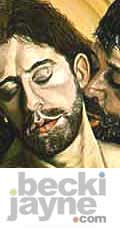
IMAGES: From top to bottom, Judas Kiss, a cropped close-up of an acrylic study for The Last Supper, and The Raped Virgin.

UPDATE: Seems that I have joined the clan of the Fey Women in subverting necrophilia. Well, I was certainly born to be Wild. Ha!

Tuesday, May 02, 2006

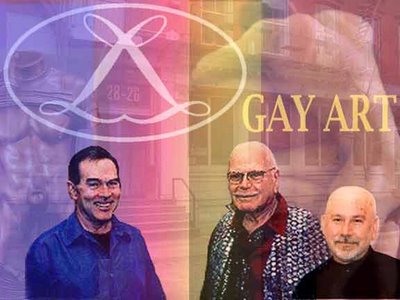
Champions of gay art

L to R: Charles Leslie, Fritz Lohman, and Wayne Snellen.
Featured artists in the above montage, L to R: Douglas Holtquist and Li Ming Shun

Tonight, Leslie-Lohman Gay Arts Foundation opened a new gallery space in Soho, New York, an occurrence that might seem un-extraordinary. But Charles Leslie and Fritz Lohman aren't ordinary. They're pioneers of gay art history and still thriving when others failed. Leslie and Lohman opened the first major gallery during the 1970s exclusively devoted to explicitly gay art after having begun shows at their Prince Street loft the year of the Stonewall riots. An entry at GLBTQ, an encyclopedia of gay, lesbian, bisexual, transgender, and queer culture, quotes Charles Leslie:

"We regard our work as part of the gay liberation movement."

Indeed, they do. Charles W. Leslie and J. Frederick Lohman, ASID, paved the way, liberating gay artists from obscurity when other galleries wouldn't dare show homoerotic or politically-incorrect queer art for fear of offending a right-leaning mainstream or a homophobic backlash. It takes grit and courage especially when you're members of a minority scorned inappropriately with religiously-charged invectives (sodomites!), marginalized, and denied the rights that most Americans take for granted. And Leslie and Lohman did it when the gay liberation movement was initially taking root and long before ground-breaking icons, Rosie, Ellen, and Missy Etheridge, crashed the pink ceiling coming out of the closet publicly. Rosie and Missy were barely teenagers when Charles and Fritz opened their doors at the Leslie/Lohman Gallery on the corner of Broome and Wooster in 1975. Douglas Blair Turnbaugh at GLBTQ wrote of their early history:

Although the Leslie-Lohman gallery did not make money, it was a succès d'estime and inspired others. By 1980 there were six gay art galleries in New York City, creating a new and vibrant social and cultural circuit for an avid gay public. Then the AIDS crisis struck, and in the terror many gay businesses that had celebrated gay sex, particularly baths, bars, and movie houses, closed or were shut down. Among these casualties were art galleries.

By the late 1980s, Leslie and Lohman had reconsidered, with a raised consciousness, the issues of gay art and gay liberation. They decided to address these issues by setting up a foundation, in order to have the same tax-exempt status enjoyed by religious, educational, philanthropic, and other not-for-profit organizations.

In 1990, after relentless work by their lawyers--and homophobic responses challenging the organization's goals and purposes--the Leslie-Lohman Gay Art Foundation came into being. Its name is the first time the word "gay" appeared in the federal government's registry of not-for-profit organizations.

[...]

Since its founding, the foundation has shown the work of 550 artists in more than 200 exhibitions; and its permanent collection has grown to approximately 1,000 pieces, including paintings, sculpture, drawings, and photography.

Examine the list of gay artists whose work has been exhibited at the Leslie-Lohman gallery, click through their exhibition history, and you will find prominent names--Paul Cadmus, Keith Haring, Delmas Howe, Robert Mapplethorpe, Tom of Finland, Wilhilm Von Gloeden, Bruce Weber--to recognize a few. There are so many. Unlike traditional galleries, LLGAF doesn't sell art, acting more as a conduit for artists and collectors (although art is sold during scheduled exhibitions), which helps working artists to survive rather than struggle with the typical 50% to 60% commission that most galleries retain. Such an arrangement keeps artists healthy and art-ing to illustrate that Charles and Fritz put compassionate heart into their visionary efforts.

LLGAF also publishes The Archive, its official newsletter, and its website displays, Milestones: "A Timeline of Gay and Lesbian Artists and History," a comprehensive reference for uninitiated queer culture newbies.

As LLGAF debuted in their new expansive space designed by architect Anthony Pellino in one of New York's oldest cast-iron buildings, the opening gala kicked off, "The Culture of Queer," a tribute to J.B Harter with nine Louisiana artists, and works from Leslie-Lohman's permanent collection. Curated by David S. Rubin from the Contemporary Arts Center in NOLA, the artwork, LLGAF's first traveling exhibition that premiered at CAC, scarcely survived Katrina when the hurricane roared ashore. If you're in NYC, catch the show through Jul. 1 to bolster artists recovering from Katrina and visit a leading gallery and champion of gay art. More LLGAF exhibition schedules and event information are here.

To make a full disclosure since some bloggers have covert agendas and hidden sponsors, I've exhibited at LLGAF twice, showing Judas Kiss in "Vulvavision," 1995, LLGAF's second lesbian group show, and Madonna, Lover & Son in the "Religious Content in Contemporary Lesbian and Gay Art" show in 1998. Naturally, I support LLGAF's mission being a working gay artist and vice versa. If not for the bravery of LLGAF and the Faces of Jesus Gallery (in a Baptist church... wow!), controversial art such as mine and other gay artists might remain only available on the Internet and in publications--venues that can't possibly convey the dynamic impact of viewing the actual artwork.

Props to Charles, Fritz, Wayne Snellen, the director of LLGAF, and the foundation's dauntless staff.

Besides making a tax-deductible contribution to LLGAF, I can't think of a worthier gay culture cause than buying gay art especially during these regressive political times for the sake of GLBT heritage, in support of artists, and perhaps donating art to the LLGAF permanent collection. Consult your tax advisor, but IIRC, donated art to a legit non-profit organization still offers a tax deduction. The tax code discriminates against artist donations but patron donors can deduct the fair market value. And living artists (*cough*) would appreciate the patronage.