Showing posts with label Gender issues. Show all posts

Wednesday, October 29, 2008

Getting away with rape


From the Houston Chronicle, a news report from the Los Angeles Daily News, Oct. 25, 2008, 8:29PM, written by Rachel Uranga:
Backlog of 7,000 untested rape kits swamps LAPD
Many cases are at risk because of a 10-year statute of limitations

...There is a backlog of more than 7,000 rape cases, and City Controller Laura Chick blasted the department in an audit for leaving thousands of victims without justice. More than 200 cases are in danger of reaching the statute of limitations for testing.

Takes longer than on TV
But ask any of the more than two dozen criminalists who work in the lab what the holdup is, and you'll get variations on the same answer: It's a lot harder to analyze DNA than it looks on TV.

"The public's perception of it is based on what they see in television or on the news," Blanton said last week. "That is not going to give you a full understanding of the complexity of it, of the legal requirements you have to follow, of the guidelines and protocols."
So it's the public's fault. M'yeah. Sure. Throw us another red herring. Who decides what funds go where?
Even though the number of reported rapes in Los Angeles has steadily declined over the past few years, the number of rape kits that have yet to be tested has grown from roughly 3,300 five years ago to more than 7,000 today.

After 10 years, if a kit is not tested, it's no longer admissible in court. But if it's tested within two years, there's no statute of limitations for when the evidence can be submitted.

The main problem is that the LAPD never staffed the lab to deal with so many cases. But there are other factors.

In about 2000, the department ordered analysts to keep every shred of cell evidence in rape cases, just in case they might need to test it. Before the change, rape kits were regularly purged from the property division, with the permission of an investigating officer.

And as DNA science became more exact, the criminalist's job grew not only harder but longer.

Winding route to DNA
LAPD Chief William Bratton has said there simply isn't enough money, and though the city has approved the addition of 16 criminalists, there is still no funding. As it is now, the division can't keep up with the current DNA case demand, 80 percent of which are rapes. [Italics mine.]
First, it's inexcusable. Heckuva job, LA! Second, is there a backlog due to a lesser priority in funding investigations into sexual violence against women? WTF is the mayor and the police chief going to do about the backlog? Ignore it?
Meanwhile, rapists go loose to rape again.

The LA Daily News blog added this detail:
At a City Hall news conference with women's-rights advocates, [City Controller Laura Chick] said the LAPD should find the money within its more-than-$2 billion budget to hire more criminalists and aim to clear the backlog within three years.

"Today, there are 7,000 women out there without a voice," Chick said. "There are 7,000 victims without justice."
Imagine if women who don't report their rapes, raised their hands. LA can't be the only major metro facing a rape-kit processing backlog. A few seconds googling proves they are not. Via WashPost in July:
The backlog of untested evidence gained national attention in 2001 when Debbie Smith, a rape victim, testified before Congress. The Debbie Smith DNA Backlog Grant Program was started in 2004 with the goal of processing the nearly 400,000 untested rape kits nationwide. But the program has been expanded to allow states to test backlogged DNA evidence from any crime. Even as the proportion of rape victims who report their assaults is increasing, the processing of rape evidence is still backlogged -- and the arrest rate of rapists is decreasing....

...States had long claimed that money was the obstacle to processing more rape kits. Over the past four years, Congress has allocated hundreds of millions of dollars for states to conduct DNA testing on evidence from rape crime scenes. Last year, 46 states, the District and Puerto Rico received grants totaling more than $43 million. But the backlog stems from more than a lack of money. The dynamics that contributed to the backlog, chiefly a failure to treat rape as seriously as other violent crimes, have been re-created in the way states spend the grants. [Emphasis added.]
More stats and disheartening news at the WashPost link, a story written by Sarah Tofte and buried on page A21. Not only is rape of lesser concern, but authorities have redirected tax dollars -- our tax dollars -- originally allocated to address rape-kit backlogs.

Don't overlook this factoid: of DNA evidence collected by LAPD, 80% involved rape!
My heart goes out to the women who have a high-probability of justice denied and those who may yet sadly experience rape because law enforcement let perps get away, our government reneges the pledge, "justice for all."

The institutions of law enforcement, the judicial system, Congress, and state governments provide four examples of the many ways that men get away with rape.
POSTSCRIPT: I have a breather from the death in my family to check in with favorite bloggers. If you haven't been following Anglachel's recent commentary focused on misogyny and all its forms, e.g, sexual violence, hate speech, the lack of attention to solving the problem, how racism deserves attention but misogyny is "excusable," plus more, and men's denial and ho-hum response, go read here and here and here for starters.

I'm a very time-starved individual (and insomniac) at the moment beyond the family emergency and can't add much depth. A few posts from my archive demonstrate that the war on women is real and personal to me (that's another tale). What I can do with relative ease and on a regular basis is cut and paste, point out newsworthy stories and white papers. It takes a few seconds to google.
All you awake men who love women are excused that's if you're helping us to solve misogyny in its variant manifestations. Options can range from activism to being a role model within your sphere of influence. Joseph at Cannonfire calls out lickspittle hate of the Blog Boyz as do our allies of the mighty Corrente building.

The spectrum of participation is broad, so c'mon! Join in, fellas! We females need your help and you can impact your male peers and family members in ways we can't to nip the toxic bud before it blooms. As I write this invitation, I'm skeptical that but a very few men will heed the call, that I'm naive to how most men won't acknowledge their privileged status or relinquish share it. Maybe wasting pixels.

Prove me wrong.


UPDATE: CLD of SoapBoxBlog kindly informed me that Jeff Fecke, whom I had mentioned, no longer blogs at Shakesville. Obviously, I need to get out more often. Revised text accordingly, added links, in a hurried rush to deal with family stuff.

Comments captured below:

Thursday, October 12, 2006

Violence against women worldwide

Women! Let us join together to heal our plight.

On Tuesday, the United Nations issued a report collected from studies involving 71 countries:

Violence against women is "severe and pervasive" worldwide, with at least one in three women experiencing abuse by an intimate partner at some point in their lives...

Undersecretary-General for Economic and Social Affairs Ocampo called violence against women...

..."a pervasive phenomenon – it's really a global problem that has to be addressed."

"According to the quantitative estimates, which certainly underestimate the amount of violence that occurs, at least one out of three women experiences violence at some stage of their lives," he said. "The report states that the major form of violence takes place at the domestic level, in the households ... and it takes place in societies throughout the world."

In addition to spontaneous violence, the report also condemned what it found to be high levels of institutionalized violence, such as female circumcision, estimating that 130 million girls and women living today had undergone this practice.

Women are not receiving adequate protection from their governments, the report said, finding that 102 member states had no specific laws on domestic violence. The report also found that martial rape was not a prosecutable offense in at least 53 states, and only 93 have laws to prevent female trafficking.

Rachel Mayanja, the secretary-general's special adviser on gender issues, said the curtain has been raised on violence against women and it's now time to act in a coordinated way "to try and eliminate this scourge."

"We are going to try to end impunity — (ensure) that those who are violating women will be prosecuted, will be punished, and that none of them will be allowed to continue to prey on their women," she told the news conference. "This is the hope — that this study can galvanize this kind of action."

The report urged governments to take action to bridge the gap between international policy and national laws, including securing gender equality, gathering more data on violence against women and allocating more funding for its prevention.

Violence against women affects whole societies, the report said, citing the costs of treating women injured both physically and emotionally, the effect of the violence on children, the loss of employment productivity, and the cost of bringing perpetrators to justice.

Additionally, fearing abuse from a sexual partner, women don't get tested for HIV, don't divulge their HIV status, or seek medical treatment.

"We cannot make poverty history unless we make violence against women history," U.N. Population Fund Executive Director Thoraya Ahmed Obaid said in a statement.

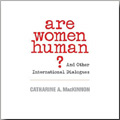
In July, Martha Nussbaum at The Nation reviewed Catharine A. MacKinnon's book, Are Women Human?

In the two most deeply troubling articles in the collection, "Genocide's Sexuality" and "Women's September 11th," MacKinnon examines the internationally accepted definitions of genocide and terrorism, and argues that many acts of men against women meet one or both of these definitions. As defined under the UN convention on genocide, genocide is either killing or inflicting serious bodily or mental harm on members of a group, with intent to destroy that group either entirely or in part. The groups mentioned are "national, ethnical, racial, or religious" groups: So in that sense violence against women clearly doesn't qualify. On other grounds, however, one could argue that a great part of violence against women does involve a similar infliction of "serious harm" on women because they are women, and its aim can be said to be to destroy "in part"--for "destroy," if mental harm is sufficient for genocide, must mean not "kill" but "remove from the ranks of the fully human"--something that happens to women all the time.

At that time I wrote:

We hear of post traumatic stress disorder and its usual association with soldiers of war but the most common PTSDs are those not of men in war, but of women in civilian life. Judith Herman, M.D., in her book, Trauma and Recovery, described the "domestic captivity" of women and children, "those subjected to totalitarian systems in sexual and domestic life, including survivors of domestic battering, childhood physical or sexual abuse, and organized sexual exploitation." A quick glance of domestic violence statistics... will confirm that the casualties of the private sphere rival those in the public sphere. I repeat MacKinnon's question, so why isn't this political?

The question begs an answer, doesn't it? Well, actually it demands solutions.

Here in America, Bonnie Erbe of U.S. News & World Report writes:

Right now there are 14 women in the U.S. Senate (five Republicans nine Democrats) and 67 in the U.S. House (24 Republicans and 4 Democrats.) As recently as 31 years ago, there were 19 women in th U.S. House and none in the Senate. That number has risen in each election–stubbornly molasseslike, according to some anxious observers (present company included), but risen nonetheless.

John Fortier, an American Enterprise Institute scholar writing in the Hill newspaper, says the current climate favors women. He writes: "Research shows that women do just as well as men in running as incumbents, challenging incumbents, and running for open seats. As more seats open up and as the number of women running for office increases, so inevitably does the number of women in Congress rise. According to the Center for American Women in Politics, there are 139 women running for the House on major-party tickets and 12 in the Senate, significantly up from 20 years ago. And as the National Council on State Legislatures reports, the pool of potential female candidates with political experience is deep, as women make up 22.6 percent of state legislatures."

Still, it's unclear whether this year will turn out to be another "Year of the Woman" in national politics. At least, things do not appear to be shaping up that way. While women may hold more seats in Congress, it could be just a handful more. The Hill, for example, projects a gain of one or two seats for women in the U.S. Senate and a pickup of six to 10 seats in the House. What's more, I've been hearing a lot about women securing major-party nominations to challenge other women in this political season, and I've wondered whether 2006 might be a record year for women in that regard. Sorry, nope, says the Center for American Women in Politics at Rutgers University. In 1998, 14 women ran against women (one in the Senate and 13 in the House). This year, there are 11 such woman vs. woman races–nine in the House and two in the Senate. So, unless there is a sudden turn of events, the pace of change will remain, well, stubbornly molasseslike.

Politically, more women must step up. It's too late for this year's election but all of us women need to keep the eye on the prize: Get women elected, support women running for office (except for the Republican Stepford Wives), and change the laws to abate violence against women.

IMAGES: Raise The Veil: Repent and Raise The Veil: Forbidden from artist Tricia Grame.

Digg! Digg this story

Monday, October 09, 2006

250 million children raped

Saw this via the Salon Dauo Report from Morgaine at What She Said!

Over 250 million children raped each year...

Morgaine cited a United Nations report:

They include 73 million boys and 150 million girls, according to a United Nations report prepared by Secretary General Kofi Annan’s independent expert, Paulo Sergio Pinheiro. Save the Children Director Dumisani Mnisi, at a workshop closing ceremony for station commanders last Thursday, shared the content of the study with police officers. “The Pinheiro study finds that shocking levels of violence affect the lives of children in all parts of the globe,” Mnisi stated.

The report states that, usually, the [250 million] children are raped by someone within the family circle. It further estimates that between 133 and 275 million children, annually, witness domestic violence.

Pinheiro also found that corporal punishment such as caning and beating was still standard practice in schools in a number of countries, and often results in school drop-outs. He estimates that between 20 and 65 percent of school age children claim to have been verbally or physically bullied in a 30-day period. Also, he reports that 126 million children are involved in hazardous work, often enduring beatings, humiliation and sexual violence by employers while institutionalised children [whether in orphanages or detention facilities] are at a particular risk of violence from the staff responsible for their care including torture, beatings, isolation, restraints, rape and harassment. Meanwhile, violence in the family in the form of harsh punishment is common in both industrialised and developing countries. Children in all regions have reported the physical and psychological hurt they suffer at the hands of their parents and care-givers.

The report also states; “over 500 000 children a year die as a result of homicide with between one and two million treated for violence-related injuries. The majority of violent acts against children are said to be perpetrated by people who are part of their lives such as parents, teachers, schoolmates, employers and care-givers. In only 16 States has all violence against children been prohibited, leaving the vast majority of the world’s child population without adequate legal protection from violence.

“Violence against children incurs extraordinary costs to society and is linked to lifelong social and health problems, including post-traumatic stress disorder, depression, anti-social and aggressive behaviour, substance abuse, lung, heart and liver diseases, impaired academic and work performance, problematic peer relations and greater involvement with the criminal justice system,” states the report.

I agree with Morgaine:

Matriarchal cultures don't view children or their mothers as property. That's a really important concept that we really need to get down under and comprehend its effects. We have to root it out of our psyches. Sexual abuse is not common in undisturbed indigenous cultures. James DeMeo has traced the source of sexual and physical violence against children to a region he calls Saharasia, beginning around 4000 b.c.e. It has spread through modern cultures as patriarchy moved throughout the world. Its origins lie in sexual and somatic repression coupled with violent treatment of infants and children. It's a remnant of a time when dominant cultures reacted to starvation with violence, greed, theft, slavery and genocide overrunning peaceful, agrarian matrifocal societies. Over the millenia, these abberant human behaviors have become institutionalized. We've been taught from infancy that these are natural tendencies that civilization must overcome. We've been taught to admire warriors, robber barons, slave traders - the Stanley Kowalski's and Gordon Gekko's of the world. There is nothing normal or human about this behavior.

Get that. It's not normal. Healthy humans don't wage war, rape, steal, kill one another for any reason. It isn't natural - it's sickness. Hurting each other is sickness. Taking more than you need, taking from one another that which is not freely given is sick. Humans are social, cooperative beings. We have the capacity for empathy - all mammals do. The natural instinct of the human animal is to protect babies. Even other species will protect babies from different animals - I've seen huge dogs lie quietly while kittens nap on their backs, and I've seen more than one pet dog or cat intervene when a parent attempted to "discipline" a child. The irony is that physical "discipline" does just the opposite - violence, aggression, and delinquent behavior in youngsters is a direct result of violent and oppressive treatment.

I know I'm repeating myself. I feel as if I'm shouting in the wind. What will it take to make us wake up to the fact that human beings are naturally peaceful and cooperative? What is going to bring us back to that natural instinct to protect children. To feed them if they're hungry, to soothe them if they're frightened, to allow them to grow strong and unbroken by anger or intimidation? To stop the multi-generational cycle of sexual abuse of children?

[...]

There's a meme going around Live Journal these days that begins with the following quote:

"Why is it that, as a culture, we are more comfortable seeing two men holding guns than holding hands?" - Ernest Gaines

My question is Why is it, as a culture, we find it more necessary to spank a child than to hug it? Both questions have the same answer - patriarchal dominance and erotophobia.

Yup, I agree. And who is perpetrating most of this abuse? Anyone one want to guess? This latest news report didn't say but a 2003-2004 Save The Children paper commissioned by the Alliance Gender Task Force for the UN Global Study on Violence against Children offers this (PDF) summary:

An analysis of the global persistence and even escalation of violence in all areas of life, including homes, communities, institutions, and armed conflicts, reveals that the vast majority of people damaged by the decisions made and the actions carried out by those in power (largely men) are children (and women). For example, children constitute almost half of the 27.4 million refugees and the 30 million displaced people worldwide (http://www.un.org/rights/concerns.htm). Some facts about and forms of violence against children and the different gender impacts follow this introduction.

Particular forms of violence, such as sexual exploitation or incest, occur disproportionately against girls, although some studies show that in some Asian countries sexual abuse of boys is nearly as common as of girls. In addition, other cultural forms of violence, such as dowry related abuse and acid throwing, in Bangladesh, Pakistan and India for instance, only affect girls and women, and carry life-long health consequences (e.g. mutilation; disfigurement) or even result in death.

Self-inflicted violence in the form of eating disorders such as anorexia nervosa and bulimia, increasingly found in Europe, also mainly affect girls. Certain forms of violence, however, such as the recruitment of boys into armed groups and drug gangs, involve a greater proportion of boys as both victims and perpetrators. Other instances of gender-based violence mainly affecting boys are the murders of street boys in Central and South America carried out by police or death squads who argue that they are preventing future violent crimes.

Gender-based violence also occurs in the process of bringing up children in their family homes and in educational institutions where corporal punishment is considered an educational tool (Innocenti Digest, No.2). This kind of violence against the child is also gendered: while physical punishment is more often inflicted upon boys, girls suffer an enormous amount of psychological abuse to force them to conform to traditional gender stereotypes. Assumptions that boys are physically stronger than girls and that physical abuse helps them grow as proper men underlie these differential expressions of gender-based violence. In addition, discriminatory ideas about children being inferior to adults, and that parents are entitled to use violence to educate their children are also seen in the use of punishment as an educational tool.

[...]

It is well documented that men, in general, have power and control over women and girls, often through violence. This appears as a global phenomenon, taking different forms that cross cultures, and being perpetuated through patriarchal structures and by the socio-economic situation of the perpetrators and the abused women and children (UN, 1996). Girls and boys are socialised into differentiated gender roles that place them within unequal structures of power. Gender inequality disempowers girls by giving them unequal access to resources and not allowing them to participate in decisions that affect them within the family and community. Although this seems to be the general treatment both boys and girls receive from adults, discrimination against girls and women and devaluing views of them, disadvantage girls even more than boys in certain matters. Girls, for example, have less access to education than boys because they are primarily seen as future wives and mothers.

Gender inequality is entangled with power relations, with issues of who defines cultural values and practices, and with the wider framework of social relations between families and communities (e.g. racial, ethnic, caste and social class inequalities). The Optional Protocol to the CRC (art. 10.3) recognises poverty and underdevelopment as root causes and facilitating factors of the trafficking of children for the sale of children, child prostitution and pornography. Poverty plays an important role in perpetuating gender-based violence by creating the material background that makes children of poor families vulnerable to certain forms of violence like those mentioned above. Children affected by abuse while living in the streets or working in forced labour, for instance, are denied access to knowledge, information and education. This, in turn, prevents them from improving their economic situations and forces them to raise their own children in poverty, thereby making them vulnerable to violence and continuing the cycle of disadvantage and oppression.

Pitiful, truly pitiful. The statistics for child abuse and violent crime in America don't make the picture any less pitiful. Violence, oppression, abuse is rampant and most of the perps are male. Visit the Dept. of Justice and explore F.B.I. crime stats for proof and the ugly reality.

Monday, August 14, 2006

The Bible is not the source

Reviewing Wayne Grudem's book, Evangelical Feminism & Biblical Truth: An Analysis of More Than 100 Disputed Questions, more errant Biblical literalism:

Click here for the first post in this series.

Chapter two looks at what roles Scripture states men and women ought to perform in the church. This week, we’ll look at the theoretical case now, and then next week we’ll look at the second half of the chapter’s practical application.

The first point, as it ought be, is that the church should recognize the equal value and dignity of men and women. “Both men and women are in God’s image, and we share that status equally. We are equally valuable to God and equally important to God’s work in the world and in the church. In the New Testament, the Holy Spirit is poured out in a new kind of fullness on both men and women.” (62) However, equal value does not mean equal function. [With emphasis added in boldface.]

I disagree with the equal but separate function philosophy. When did Christ present two separate roles: One for women and one for men? He didn't as best as we can tell given the way the church patriarchy altered New Testament scriptures. More from the review:

With Scripture as our foundation, we should consider where the lines in church practice should be drawn. “We should not make rules that the Bible does not support, and we should not add restrictions to ministry positions when the Bible does not justify these restrictions. Where the Bible allows freedom, we should encourage ministries by women as well as men.” (63)

I strongly disagree with "Scripture as our foundation" thinking. God is the source--not the Bible. From the first post in the series comes...:

This Biblical model can only be worked out when husband and wife each avoid errors of distortion in either being too passive or too aggressive with their roles. Apart from headship, the man’s responsibility is to provide for and protect his family. Apart from support, the woman’s responsibility is to care for the home and nurture the children.

Wrong. The woman's responsibility is to listen to God--not to the Bible, not to the alleged "headship" of men, not to a patriarchal church with an ax to grind. Women have equal access to the Creator, the Source of All Life, for divine guidance. Looking to men for women's roles in life, church, and family, is asking the wrong source. And that's a sin and a waste of time.

People taking the Bible literally without knowledge of how the New Testament was edited by scribes who had a particular sexist viewpoint of women's roles in life and the church is tragic. To cling to the ancient past not realizing the agenda that men had in writing, copying, and altering the Gospels for ideological purposes is truly sad. A reminder from textual scholar Bart Ehrman (an evangelical who started his training at the Moody Bible Institute, not exactly a hotbed of subversiveness) not to take the Bible literally:

I became interested in the manuscripts that preserve the New Testament for us, and in the science of textual criticism, which can supposedly help us reconstruct what the original words of the New Testament were. I kept reverting to my basic question: how does it help us to say that the Bible is the inerrant word of God if in fact we don't have the words that God inerrantly inspired, but only the words copied by the scribes––sometimes correctly but sometimes (many times!) incorrectly? What good is it to say that the autographs (i.e., the originals) were inspired? We don't have the originals! We have error-ridden copies, and the vast majority of these are centuries removed from the originals and different from them, evidently, in thousands of ways.

God is still speaking and alive in our hearts and minds. Why turn to a document that has no original manuscript and is a reconstruction filled with tens of thousands of errors from 1000s of years ago for spiritual guidance when we have access directly to the Living God today? Puzzles me. Do some based-on-the-Bible-only Christians think God is dead and the Bible is the only source of wisdom? I rely on the Living Word of God directly given, inspired, moment by moment of everyday. Look within. Pray and listen. That's my advice. I don't need a flawed idiomatically peculiar book written by men with their agenda to tell me how to serve God or what a woman's role is. That's for God to say.

UPDATE: I realize that atheists or agnostics who may wander in here may take issue with some of my statements because I believe in God as the source of All That Is. The context of my post was addressed to believers. However, I am clear that my personal faith is not scientific fact. I don't believe in imposing my spiritual ideas on anyone, and that freedom of religion and free speech are best served under the separation of church and state. Substitute the word, God, with the word, Self, and that's the common ground we share. Bottom-line for me...does one's belief or non-belief serve us in making our world loving, peaceful, just, more prosperous, and free from fear for us all equally? Doesn't matter to me if you believe in 20 gods or none at all, to paraphrase Jefferson. The God I hold in my being offers no condemnation either way.

Next, I recognize that some Christians do not follow the Bible word for word. But if you have questions, pray, meditate, and listen to the inner voice. You will get answers by calling forth the Christ that is within you. Seek and you will find. Peace be unto you.